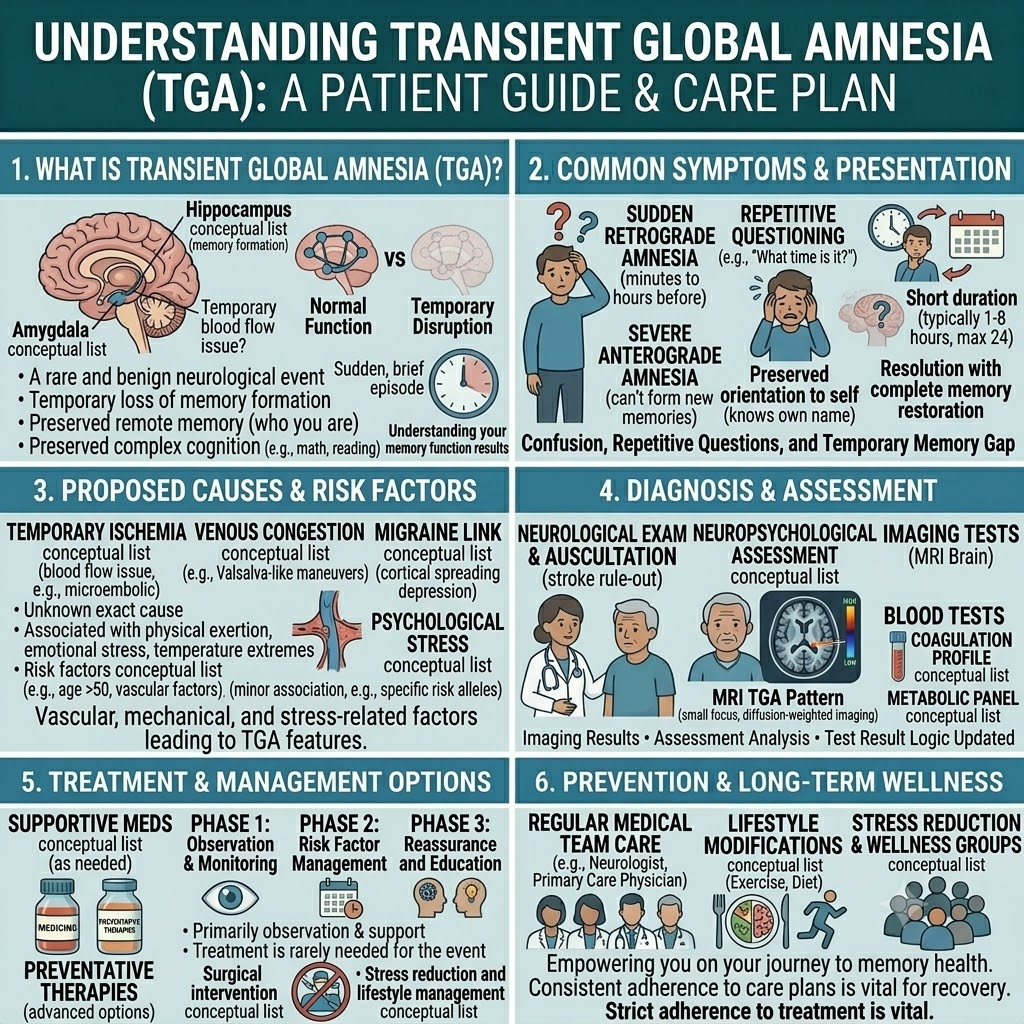
Transient global amnesia is a sudden, temporary episode of confusion and memory loss. During an episode, a person is alert and knows who they are, but cannot create new memories or recall recent events. They might repeatedly ask the same questions, forgetting the answers. This condition is not a stroke or epilepsy, typically resolves completely within a few hours without lasting effects, and most often affects middle-aged to older individuals. While harmless, an episode can be very frightening.
Understanding the Condition
Transient Global Amnesia: Temporary Memory Loss Explained
Understanding the Condition
Transient global amnesia is a sudden, temporary episode of confusion and memory loss. During an episode, a person is alert and knows who they are, but cannot create new memories or recall recent events. They might repeatedly ask the same questions, forgetting the answers. This condition is not a stroke or epilepsy, typically resolves completely within a few hours without lasting effects, and most often affects middle-aged to older individuals. While harmless, an episode can be very frightening.
Common Symptoms
Sudden Memory Loss: Inability to form new memories, forgetting what's happening or just occurred.
Loss of Recent Past Memory: Difficulty recalling events from the recent past (days, months).
Repetitive Questioning: Repeatedly asking the same questions, unable to retain the answers.
Intact Personal Identity: Remembers who they are and recognizes familiar people.
Normal Alertness: Alert and aware, without other neurological signs like weakness.
Gradual Improvement: Symptoms slowly disappear over a few hours, with memory returning.
Consultation Guide
Which Specialist to Meet
Start with your primary care doctor, who may refer you to a neurologist (a doctor specializing in brain and nervous system conditions).
Preparations Before Your Visit
Regular Medical Check-ups: Routine doctor visits monitor general health and discuss new/recurring symptoms.
Note-Taking: If an episode recurs, family should record exact symptoms, duration, and preceding events for your doctor.
Consultation Guide
Addressing Potential Triggers: While TGA's exact cause is unknown, managing conditions like migraines (if you have a history) may be discussed, as a link is sometimes suspected, though not fully understood. (Duration: Ongoing, as part of general health management.)
Diagnostic Procedures
Neurological Examination
Physical exam assessing brain, spinal cord, nerve, and muscle function; checks mental status, reflexes, coordination, and sensation. Doctors use this to confirm transient global amnesia and, crucially, to rule out more serious conditions like stroke or epilepsy that can present similarly.
What to Expect
Doctor assesses history, performs tests like checking reflexes, eye movements, strength, balance, and asks questions on memory/thinking. Painless.
Brain CT Scan (Computerized Tomography Scan)
Uses X-rays and computer to create detailed cross-sectional images ("slices") of brain, skull, and blood vessels, quickly identifying bleeding, swelling, or tumors.
What to Expect
Lie on a table moving into a scanner; hear whirring, must stay still. Contrast dye (warm sensation) may be injected to highlight structures. Quick scan.
Brain MRI (Magnetic Resonance Imaging)
Uses a strong magnet, radio waves, and computer for highly detailed brain images (sometimes neck/spine) without radiation.
What to Expect
Lie on a table in a tube-shaped machine. Expect loud knocking/thumping sounds (earplugs provided); stay very still. Scan lasts 30-60 minutes. Contrast dye may be used.
EEG (Electroencephalogram)
Measures brain's electrical activity via small electrodes on the scalp, helping detect abnormal patterns like those in epilepsy.
What to Expect
Electrodes with paste placed on scalp. Sit quietly while brain signals are recorded. May be asked to open/close eyes or breathe deeply. Painless, 20-40 minutes.
Long-Term Approaches (Post-Episode)
Treatment Options
Prepare to discuss episode details (start, duration, what was forgotten), any preceding activities, all current medications, your medical history (especially migraines), and a list of questions for the doctor.
Book a doctor visit near me
Management During an Episode
Supportive Care and Reassurance: During an episode, provide calm reassurance, help the person stay safe, and patiently answer their repetitive questions in a quiet, familiar setting. (Duration: Continuously until the episode resolves, typically a few hours.)
Prevention & Long-Term Wellbeing
Prevention and Risk Reduction
Maintain a Healthy Lifestyle: Regular physical activity, balanced diet, and adequate sleep support overall brain health.
Manage Underlying Health Conditions: Work with your doctor to manage high blood pressure, diabetes, high cholesterol, and migraines.
Reduce Stress: Practice stress-reducing techniques (e.g., meditation). Severe emotional stress sometimes precedes an episode.
Long-Term Monitoring and Coping
Educate Yourself and Loved Ones: Understanding TGA reduces fear. Inform family how to respond calmly and seek medical attention if another episode occurs.
Tags & Topics
Notice an error or need an update?
Help us keep medical information accurate. Report incorrect info or suggest an edit.


