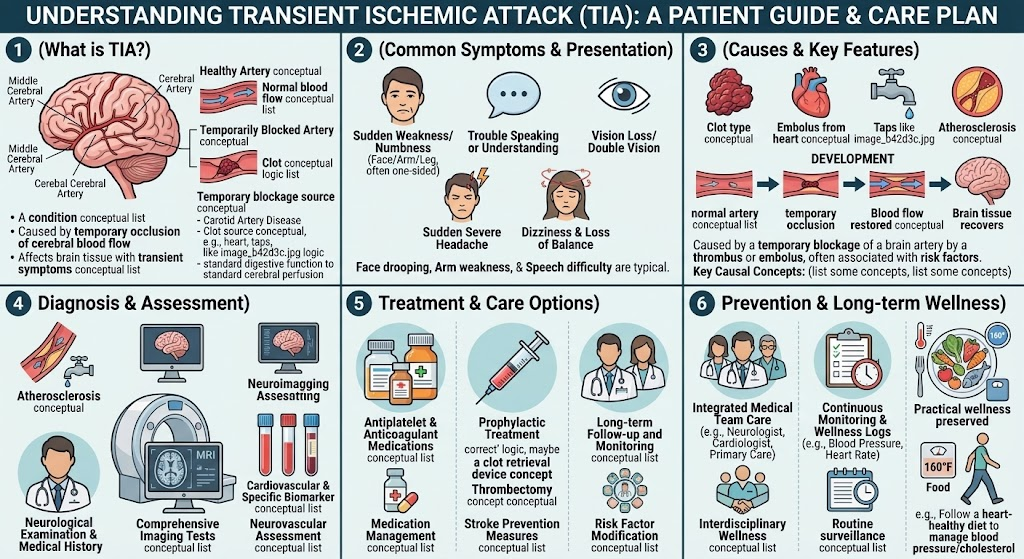
A Transient Ischemic Attack (TIA), often called a 'ministroke,' is a brief episode of stroke-like symptoms caused by a temporary disruption of blood flow to the brain. Unlike a full stroke, a TIA usually lasts only a few minutes and does not cause permanent brain damage. However, a TIA is a critical warning sign that you are at high risk for a future stroke. About one-third of people who experience a TIA will have a stroke, with many occurring within a year, sometimes even within hours or days. Recognizing and addressing a TIA promptly can help prevent a full stroke.
Understanding the Condition
Transient Ischemic Attack (TIA): A Warning Sign for Stroke
Understanding the Condition
A Transient Ischemic Attack (TIA), often called a 'ministroke,' is a brief episode of stroke-like symptoms caused by a temporary disruption of blood flow to the brain. Unlike a full stroke, a TIA usually lasts only a few minutes and does not cause permanent brain damage. However, a TIA is a critical warning sign that you are at high risk for a future stroke. About one-third of people who experience a TIA will have a stroke, with many occurring within a year, sometimes even within hours or days. Recognizing and addressing a TIA promptly can help prevent a full stroke.
Common Symptoms
Sudden Weakness or Numbness: Feeling weak, numb, or paralyzed in your face, arm, or leg, typically on one side of your body.
Speech and Understanding Difficulties: Trouble speaking clearly (slurred speech) or difficulty understanding what others are saying.
Vision Problems: Sudden blindness in one or both eyes, or experiencing double vision.
Balance and Coordination Issues: Sudden dizziness, loss of balance, or difficulty with coordination.
Consultation Guide
Which Specialist to Meet
If you suspect you are experiencing or have had a TIA, seek immediate medical attention. You will likely be evaluated by an emergency physician and may then be referred to a neurologist, a doctor specializing in brain and nervous system conditions, or a primary care physician who can coordinate your care.
Preparations Before Your Visit
Before your visit, be prepared to describe your symptoms in detail: when they started, how long they lasted, and what you were doing at the time. Provide a complete medical history, including any existing health conditions, current medications, and family history of stroke or TIA. Write down any questions you have for your healthcare provider.
Book a doctor visit near me
Consultation Guide
Measures the pressure of blood in your arteries as your heart pumps. High blood pressure is a significant risk factor for TIA and stroke.
Uses sound waves to create images of the carotid arteries in your neck, which supply blood to your brain. It helps detect narrowing or blockages caused by fatty deposits (plaque).
Uses sound waves to create moving pictures of your heart, showing its structure and how blood flows through its chambers and valves. This can identify heart conditions that might cause blood clots leading to a TIA.
Regular Medical Check-ups: Schedule routine appointments with your healthcare provider to monitor your overall health, risk factors, and the effectiveness of any ongoing treatments.
Diagnostic Procedures
Neurological Examination
A comprehensive assessment of your brain, spinal cord, nerves, and muscles to check their function. This helps identify any issues with your nervous system.
What to Expect
A healthcare professional will ask about your medical history and conduct various tests, which may include checking your reflexes, vision, hearing, balance, coordination, strength, and mental status (memory, problem-solving). This exam can take anywhere from a few minutes to over an hour.
What to Expect
A cuff will be placed around your upper arm and inflated, momentarily squeezing your arm. This usually lasts only a few seconds and measures your systolic (upper) and diastolic (lower) blood pressure readings. It is quick and generally painless.
Cholesterol Test (Lipid Panel)
A blood test to measure the levels of cholesterol and other fats (triglycerides) in your blood. High cholesterol can lead to plaque buildup in arteries, increasing stroke risk.
What to Expect
A healthcare professional will draw a blood sample, usually from a vein in your arm. You may be asked to fast for several hours beforehand. The process is quick, typically involving a brief pinch or sting as the needle is inserted.
What to Expect
You will lie down, and a gel will be applied to your neck. A handheld device (transducer) will be moved over your skin. You may feel slight pressure. The procedure is painless and allows the healthcare professional to view blood flow and artery walls on a screen.
What to Expect
Sensors (electrodes) will be placed on your chest to monitor your heart rhythm. A gel will be applied to your chest, and a handheld device (transducer) will be moved over the area. You may be asked to change positions or hold your breath briefly. The test is non-invasive and painless.
Brain CT Scan (Computerized Tomography)
Uses X-rays and computer processing to create detailed cross-sectional images (slices) of your brain, skull, and blood vessels. It quickly identifies bleeding, swelling, or other issues.
What to Expect
You will lie on a movable table that slides into a large, donut-shaped machine. You'll need to stay very still. Sometimes, a special dye (contrast) is injected into a vein to highlight specific areas. The scan is typically quick and painless, though the machine may make some noises.
Brain MRI (Magnetic Resonance Imaging)
Uses a strong magnet, radio waves, and a computer to produce very detailed images of the brain. It can detect subtle changes, tumors, stroke, or multiple sclerosis.
What to Expect
You will lie on a movable table that slides into a large, tube-shaped machine. It's crucial to remain still. The machine can be noisy, so you might be offered earplugs. Some machines are enclosed, which can be uncomfortable for some people. A contrast dye might be used. The scan is painless but can take longer than a CT scan.
CT Angiography (CTA) or Magnetic Resonance Angiography (MRA)
Specialized CT or MRI scans that focus specifically on the blood vessels in the brain and neck to check for blockages or narrowing more precisely.
What to Expect
Similar to a standard CT or MRI scan, but often requires injection of a contrast dye to highlight the blood vessels. You will lie on a table and remain still while the images are taken. The sensation and duration are similar to their respective standard scans.
Treatment Options
Medications
Anti-clotting Medications: Medicines that make blood less likely to clot, preventing new clots from forming or existing ones from growing. This is crucial for preventing a full stroke after a TIA. (Duration: Typically long-term, possibly lifelong, as directed by your doctor.)
Blood Pressure Lowering Medications: Medicines to control high blood pressure, reducing the strain on blood vessels and lowering stroke risk. (Duration: Usually long-term, possibly lifelong, requiring regular monitoring.)
Cholesterol Lowering Medications: Medicines to reduce 'bad' cholesterol levels, which can help prevent the buildup of fatty plaques in arteries. (Duration: Often long-term, possibly lifelong, with regular check-ups.)
Diabetes Management Medications: Medicines to control blood sugar levels in people with diabetes, as diabetes accelerates artery narrowing. (Duration: Ongoing, lifelong, managed in conjunction with diet and exercise.)
Procedures and Surgical Interventions
Manage Chronic Conditions: Work with your doctor to effectively manage conditions like high blood pressure, high cholesterol, diabetes, and heart disease through lifestyle changes and prescribed medications.
Prevention & Long-Term Wellbeing
Carotid Endarterectomy: A surgical procedure to remove fatty deposits (plaque) from the carotid arteries in the neck that supply blood to the brain, improving blood flow and reducing stroke risk. (Duration: A single surgical procedure, followed by recovery time, typically weeks to months.)
Carotid Angioplasty and Stenting: A less invasive procedure where a balloon is used to open a narrowed carotid artery, and a small mesh tube (stent) is inserted to keep it open. (Duration: A single procedure, followed by recovery time, typically days to weeks. The stent remains in place permanently.)
Prevention and Long-Term Wellbeing
Quit Smoking: Stopping smoking significantly reduces your risk of TIA and stroke by improving blood vessel health.
Healthy Diet: Eat a diet rich in fruits, vegetables, and whole grains, and limit saturated fats, trans fats, cholesterol, and sodium to help manage blood pressure and cholesterol levels.
Regular Exercise: Aim for at least 30 minutes of moderate-intensity exercise most days of the week to help lower blood pressure, improve cholesterol, and maintain a healthy weight.
Maintain a Healthy Weight: Being overweight increases the risk of high blood pressure, diabetes, and heart disease, all of which raise stroke risk. Losing excess weight is beneficial.
Limit Alcohol Intake: If you drink alcohol, do so in moderation (up to one drink per day for women, up to two for men) to avoid increasing blood pressure and other health risks.
Avoid Illicit Drugs: Cocaine and other illicit drugs are strongly linked to an increased risk of TIA and stroke.
Tags & Topics
Notice an error or need an update?
Help us keep medical information accurate. Report incorrect info or suggest an edit.


