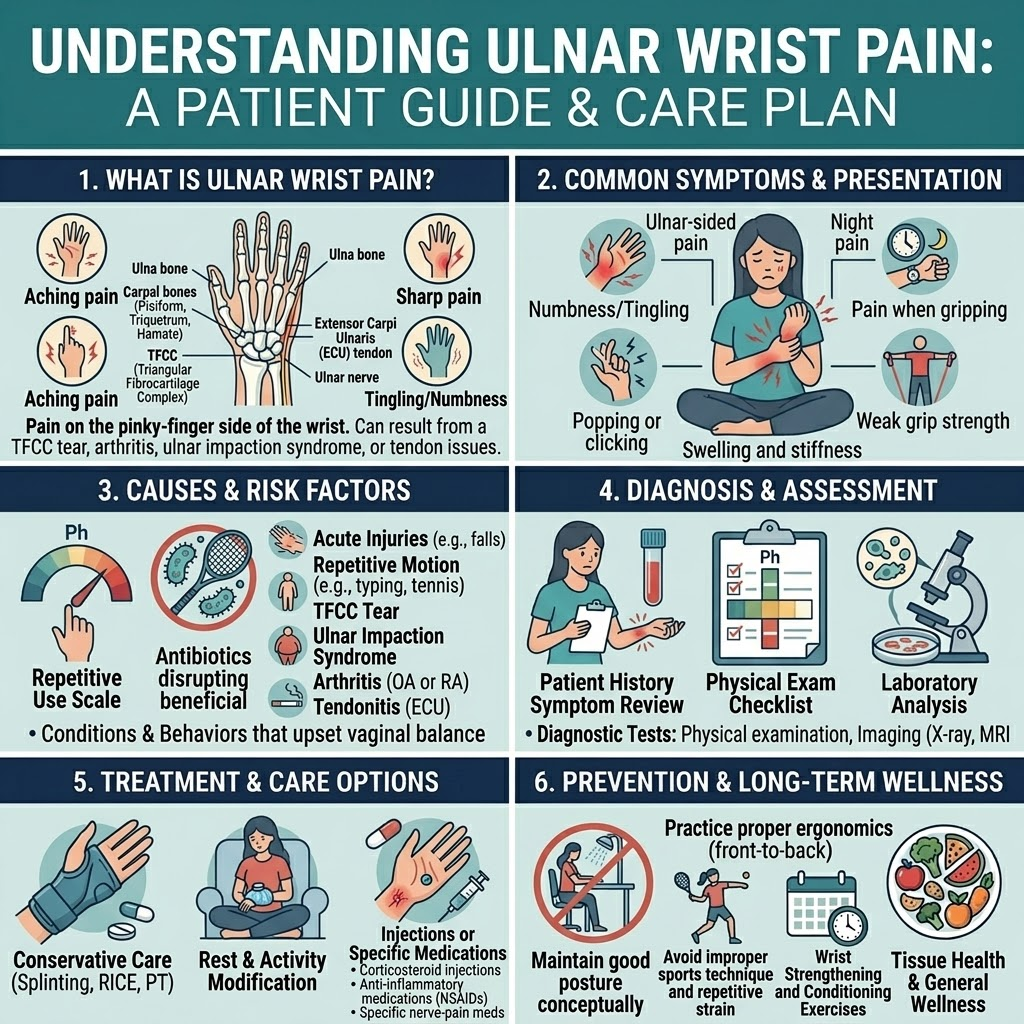
Ulnar wrist pain refers to discomfort felt on the pinky finger side of your wrist. This area involves the ulna, one of the two bones in your forearm, along with important soft tissues like ligaments (connecting bones) and tendons (connecting muscles to bones). This type of wrist pain can arise from many different issues, including injuries to these bones, tendons, or ligaments, and its exact nature can vary widely depending on the underlying cause.
Understanding the Condition
Understanding Ulnar Wrist Pain
Understanding the Condition
Common Symptoms
Pain on the Pinky Side of the Wrist: Discomfort specifically felt on the side of your wrist where your pinky finger is located.
Pain Worsened by Movement: Pain that increases when you grip objects, twist your wrist, or rotate your forearm.
Weakness in Grip: Difficulty or reduced strength when trying to hold items firmly.
Limited Movement: Trouble fully bending, extending, or twisting your wrist, or rotating your forearm.
Clicking or Popping Sounds: Hearing or feeling a distinct click or pop when you move your wrist.
Consultation Guide
Which Specialist to Meet
Initially, you should see your general practitioner or family doctor. They may refer you to a specialist such as an orthopedic surgeon (specializing in bones, joints, ligaments, and tendons), a sports medicine specialist (for activity-related injuries), or a hand surgeon for more complex wrist issues.
Preparations Before Your Visit
Before your visit, list your symptoms, including when they started, what makes them better or worse, and how they affect your daily life. Be prepared to share your medical history, any recent injuries (like falls), and a history of repetitive tasks. Write down any questions you have for the doctor. Wear loose clothing that allows easy examination of your wrist and arm.
Book a doctor visit near me
You'll describe your symptoms and medical history. The doctor will physically examine and move your wrist, which might cause some temporary discomfort to pinpoint the source of pain.
Uses a small amount of radiation to create images of your bones, helping to identify fractures, arthritis, or other bone abnormalities.
Monitor Symptoms: Be aware of any return or worsening of pain or other symptoms and consult your doctor promptly if they occur.
Consultation Guide
Ulnar wrist pain refers to discomfort felt on the pinky finger side of your wrist. This area involves the ulna, one of the two bones in your forearm, along with important soft tissues like ligaments (connecting bones) and tendons (connecting muscles to bones). This type of wrist pain can arise from many different issues, including injuries to these bones, tendons, or ligaments, and its exact nature can vary widely depending on the underlying cause.
Uses powerful magnets and radio waves to create highly detailed images of your wrist's soft tissues, including ligaments, tendons, cartilage, and nerves. Often used when X-rays don't show the cause of pain.
For NCS, small electrodes deliver mild electrical impulses causing a twitching sensation. For EMG, thin needles are inserted into muscles to record electrical activity, which can cause some temporary discomfort. The test usually takes 30-60 minutes.
Diagnostic Procedures
Your doctor will assess your wrist for pain, swelling, and range of motion by visually inspecting and gently moving your wrist and forearm.
What to Expect
What to Expect
You'll position your wrist on a table or against a plate. It's a quick, painless procedure that requires you to stay still for a few seconds while images are taken.
Magnetic Resonance Imaging (MRI)
What to Expect
You will lie on a movable table that slides into a large, tube-shaped machine. The machine can be noisy, so you might be offered earplugs. You must remain very still during the scan, which can take 30-60 minutes.
Computed Tomography (CT) Scan
Combines multiple X-ray images from different angles to create detailed cross-sectional (3D) views of your wrist, including bones and surrounding soft tissues. Useful for complex fractures or subtle bone changes.
What to Expect
You will lie on a narrow table that slides into a donut-shaped machine. The table will move through the scanner while it takes images. The process is usually quick (5-15 minutes) and painless, though you may hear buzzing or clicking sounds.
Uses high-frequency sound waves to create real-time images of soft tissues, showing movement and blood flow. Useful for assessing tendons, ligaments, fluid collections, and nerve issues in motion.
What to Expect
Gel will be applied to your wrist, and a small handheld device will be gently pressed against your skin and moved over the area. It is painless and typically takes 15-30 minutes.
Nerve Conduction Studies / Electromyography (NCS/EMG)
These tests measure the electrical activity of nerves and muscles to identify nerve damage or muscle disorders if nerve compression is suspected.
What to Expect
Diagnostic Injections
What to Expect
The skin will be cleaned, and a local anesthetic may be used. A thin needle is then guided into the target spot (sometimes with imaging). You might feel a brief sting or pressure. You'll be monitored briefly afterward.
Arthroscopy: A minimally invasive surgery where a small camera is used to diagnose and repair issues like torn ligaments or cartilage through tiny incisions. (Duration: Recovery typically 4-12 weeks)
Treatment Options
A small amount of numbing medication (often with a steroid) is injected into a specific area of the wrist where pain is suspected. If the pain temporarily resolves, it helps confirm that the injected area is the source.
Rest: Avoid activities that worsen your pain to allow the wrist to heal. (Duration: Days to weeks, until pain subsides)
Ice/Heat Application: Apply ice packs for acute pain and swelling, or heat for muscle stiffness. (Duration: 15-20 minutes, several times daily as needed)
Over-the-Counter Pain Relief: Use oral pain relievers or topical gels to manage pain and inflammation. (Duration: As needed for pain relief)
Medications
Prescription Anti-inflammatory Medications: Stronger medications prescribed by a doctor to reduce significant pain and inflammation. (Duration: As prescribed by your doctor, typically weeks)
Other Pain Management Medications: May include specific medications for nerve pain or muscle relaxants if indicated. (Duration: As prescribed by your doctor)
Therapies
Physical Therapy: Guided exercises to improve wrist strength, flexibility, and overall range of motion. (Duration: Several weeks to months)
Occupational Therapy: Learning ways to adapt daily activities to reduce wrist strain, and potential use of splints or braces. (Duration: Several weeks to months)
Splinting or Bracing: Wearing a device to immobilize the wrist, allowing damaged tissues to heal. (Duration: Weeks to several months, depending on the injury)
Corticosteroid Injections: Direct injection of a powerful anti-inflammatory medication into the affected area to reduce pain and inflammation. (Duration: Pain relief can last weeks to months; injections are typically limited in frequency)
Surgical Procedures
Open Surgery: More traditional surgery involving a larger incision to repair complex fractures, severe ligament tears, or address significant bone issues. (Duration: Recovery typically 2-6 months or longer)
Manage Underlying Conditions: Effectively manage conditions like arthritis or gout through appropriate diet and medication as advised by your doctor.
Adhere to Therapy Plans: Continue with any prescribed exercises or stretches from physical or occupational therapy to maintain strength and flexibility.
Activity Modification: Identify and avoid or adapt activities that aggravate your wrist pain. Find alternative ways to perform tasks if necessary.
Prevention & Long-Term Wellbeing
Specific Repairs or Debridement: Procedures to remove damaged tissue or repair torn structures, such as a triangular fibrocartilage complex (TFCC) tear, or address bone impingement. (Duration: Recovery varies depending on the specific repair)
Prevention
Ergonomic Adjustments: Set up your workspace (computer keyboard, mouse) to ensure your wrists are in a neutral, straight position.
Regular Breaks: Take frequent short breaks during repetitive tasks to stretch your wrists and forearms and rest them.
Proper Technique: Learn and use correct form and posture for sports, work activities, or hobbies that involve wrist motion.
Strength and Flexibility Exercises: Perform exercises to strengthen wrist and forearm muscles and improve overall flexibility.
Protective Gear: Consider wearing wrist guards or supportive splints during high-impact sports or activities that put stress on your wrists.
Maintain a Healthy Lifestyle: A balanced diet, healthy weight, and regular physical activity can support overall joint health and recovery.
Regular Follow-ups: Attend scheduled appointments with your doctor or therapist, especially if your condition is chronic or requires ongoing management.
Tags & Topics
Notice an error or need an update?
Help us keep medical information accurate. Report incorrect info or suggest an edit.


