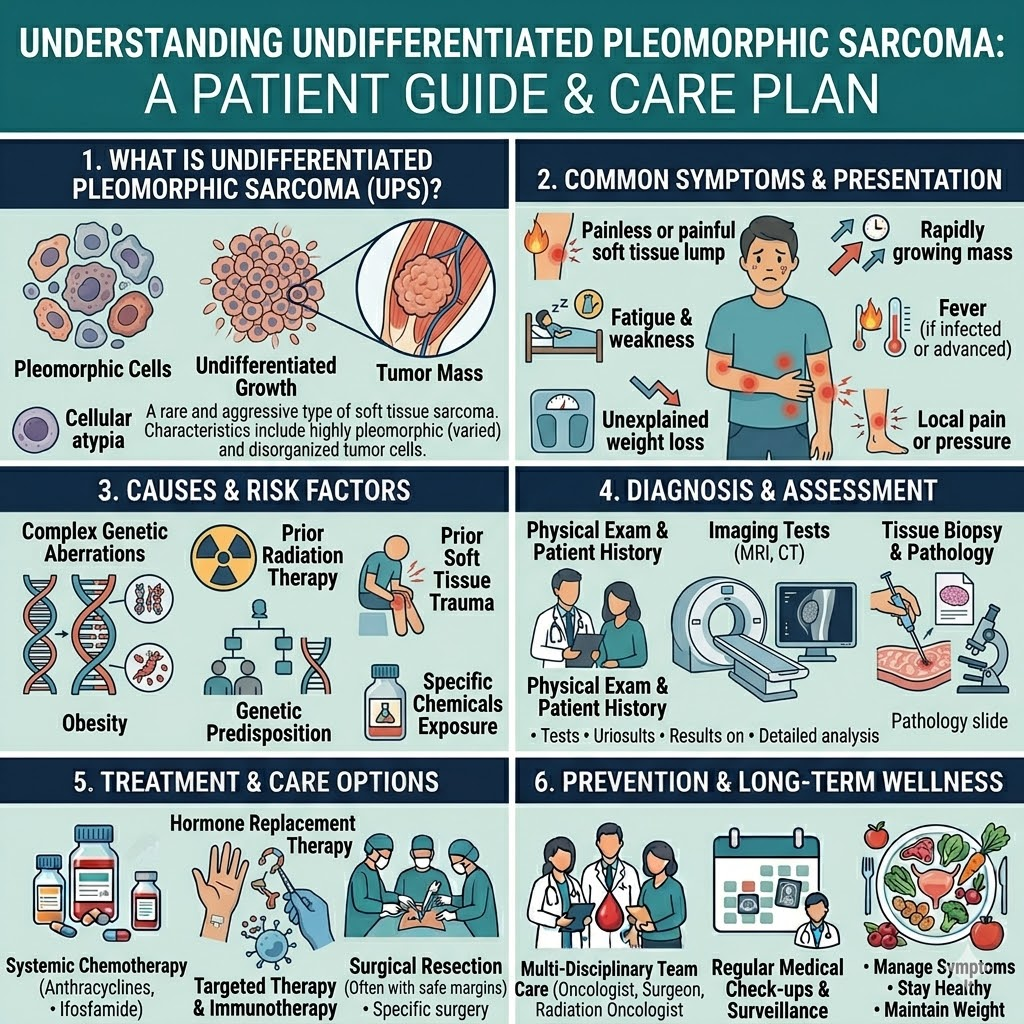
Undifferentiated Pleomorphic Sarcoma (UPS) is a rare and aggressive cancer originating primarily in the body's soft tissues—which connect, support, and surround other body structures like muscles and fat. It most often appears in the arms or legs, though it can also occur behind the abdominal organs (retroperitoneum).The name describes its appearance: "Undifferentiated" means the cancer cells don't resemble normal tissue, and "pleomorphic" signifies their varied, abnormal shapes and sizes under a microscope.UPS starts when a cell's DNA changes, causing it to multiply uncontrollably and form a tumor. These cells can invade healthy tissue and spread (metastasize) to distant areas like the lungs or bones. Risk factors include older age and, rarely, previous radiation therapy, though many cases have no clear cause. Treatment usually involves surgery, radiation, and drug therapies.
Understanding the Condition
Undifferentiated Pleomorphic Sarcoma (UPS): A Guide to Understanding a Rare Soft Tissue Cancer
Understanding the Condition
Common Symptoms
Growing Lump or Swelling: A noticeable, expanding mass or area of swelling, which may or may not be painful.
Pain, Tingling, or Numbness: If the lump grows large, it can press on nerves, causing pain, tingling, or numbness.
Swelling in Extremities: For tumors in an arm or leg, swelling might occur in the hand or foot of that limb.
Abdominal Symptoms: If in the abdomen, symptoms can include persistent pain, loss of appetite, and constipation.
Unexplained Weight Loss: Weight loss without a clear reason.
Consultation Guide
Which Specialist to Meet
Before your visit, list all symptoms (onset, changes), past medical history, medications, and family history. Prepare questions; bringing a family member can offer support.
Book a doctor visit near me
Radiation Therapy: Uses high-energy beams to kill cancer cells or shrink tumors. It can be used before surgery (neoadjuvant), after surgery (adjuvant), to manage symptoms, or delivered directly during surgery (intraoperative). (Duration: Typically 5-7 weeks, with daily sessions (Monday-Friday).)
Symptom Management: Work closely with your healthcare team to manage treatment side effects like pain, fatigue, or swelling (lymphedema). Palliative care can also improve quality of life.
Emotional and Psychological Support: Coping with cancer is challenging. Seek support from family, friends, support groups, or mental health professionals. Cancer organizations offer resources and community.
Consultation Guide
Undifferentiated Pleomorphic Sarcoma (UPS) is a rare and aggressive cancer originating primarily in the body's soft tissues—which connect, support, and surround other body structures like muscles and fat. It most often appears in the arms or legs, though it can also occur behind the abdominal organs (retroperitoneum).The name describes its appearance: "Undifferentiated" means the cancer cells don't resemble normal tissue, and "pleomorphic" signifies their varied, abnormal shapes and sizes under a microscope.UPS starts when a cell's DNA changes, causing it to multiply uncontrollably and form a tumor. These cells can invade healthy tissue and spread (metastasize) to distant areas like the lungs or bones. Risk factors include older age and, rarely, previous radiation therapy, though many cases have no clear cause. Treatment usually involves surgery, radiation, and drug therapies.
The doctor will gently feel the affected area. This is usually painless, though a tender lump might cause mild discomfort.
Healthy Lifestyle Choices: While UPS often has no clear preventable causes, a healthy lifestyle—balanced diet, regular activity, avoiding smoking and excessive alcohol—supports overall health and may indirectly reduce cancer risk.
Minimizing Radiation Exposure: If you have a history of therapeutic radiation, discuss long-term monitoring with your doctor, as previous radiation is a rare risk factor.
Long-Term Monitoring & Support
Diagnostic Procedures
Start with your primary care doctor, who may refer you to specialists like an oncologist (cancer specialist), surgical oncologist, radiation oncologist, or pathologist (examines tissues for diagnosis).
Preparations Before Your Visit
Your doctor will examine the lump or swollen area, assessing its size, texture, and tenderness, while also checking your overall health.
What to Expect
Imaging Tests (MRI, CT scan, PET scan, Ultrasound)
These tests create detailed internal body pictures to locate the tumor, assess its size, and check for spread. MRI uses magnets and radio waves for soft tissues. CT scans use X-rays for cross-sectional views. PET scans use a tracer for cancer activity. Ultrasound uses sound waves to visualize structures.
What to Expect
You'll lie on a table. CTs may use contrast dye. MRIs are noisy (earplugs offered). PETs involve a small radioactive sugar injection and waiting. Ultrasound uses gel and a wand. Procedures are not painful but require staying still for 20-60 minutes.
A biopsy is crucial for diagnosis. A small tissue sample is removed and examined by a pathologist to identify cancer type and aggressiveness. Types: Core Needle (hollow needle extracts tissue); Incisional (part of tumor removed); Excisional (entire small tumor removed).
What to Expect
For needle biopsies, local anesthesia numbs the area, and a needle is inserted, often guided by imaging. Surgical biopsies are minor procedures, usually under local or general anesthesia. You might feel pressure or a sting from anesthetic, followed by soreness/bruising.
Regular Follow-up Appointments: After treatment, consistent check-ups with your oncology team are crucial. These include physical exams, imaging scans, and blood tests to monitor for recurrence.
Treatment Options
Surgical Procedures
Surgical Removal: The primary treatment involves removing the tumor along with a margin of healthy tissue to ensure all cancer cells are gone. This is often the initial step. (Duration: Single procedure, recovery typically takes weeks to months depending on complexity.)
Chemotherapy: Uses powerful medicines, often given intravenously or orally, to kill cancer cells throughout the body. It may be used if the cancer is advanced, has spread, or if recurrence risk is high. (Duration: Cycles of treatment, typically lasting several months to a year, with breaks.)
Targeted Therapy: Focuses on specific weaknesses within cancer cells, blocking their growth and spread while minimizing harm to healthy cells. This may be considered based on tumor genetic analysis. (Duration: Ongoing, for months or years, as long as it remains effective.)
Immunotherapy: Boosts the body's own immune system to fight cancer by helping immune cells recognize and attack cancer. This is an emerging option for certain advanced sarcomas. (Duration: Ongoing, for months or years, as long as it remains effective.)
Rehabilitation Therapy: If surgery or treatment impacts mobility or function, physical or occupational therapy can help regain strength, flexibility, and independence, especially for limb tumors.
Prevention & Long-Term Wellbeing
Prevention
Tags & Topics
Notice an error or need an update?
Help us keep medical information accurate. Report incorrect info or suggest an edit.


