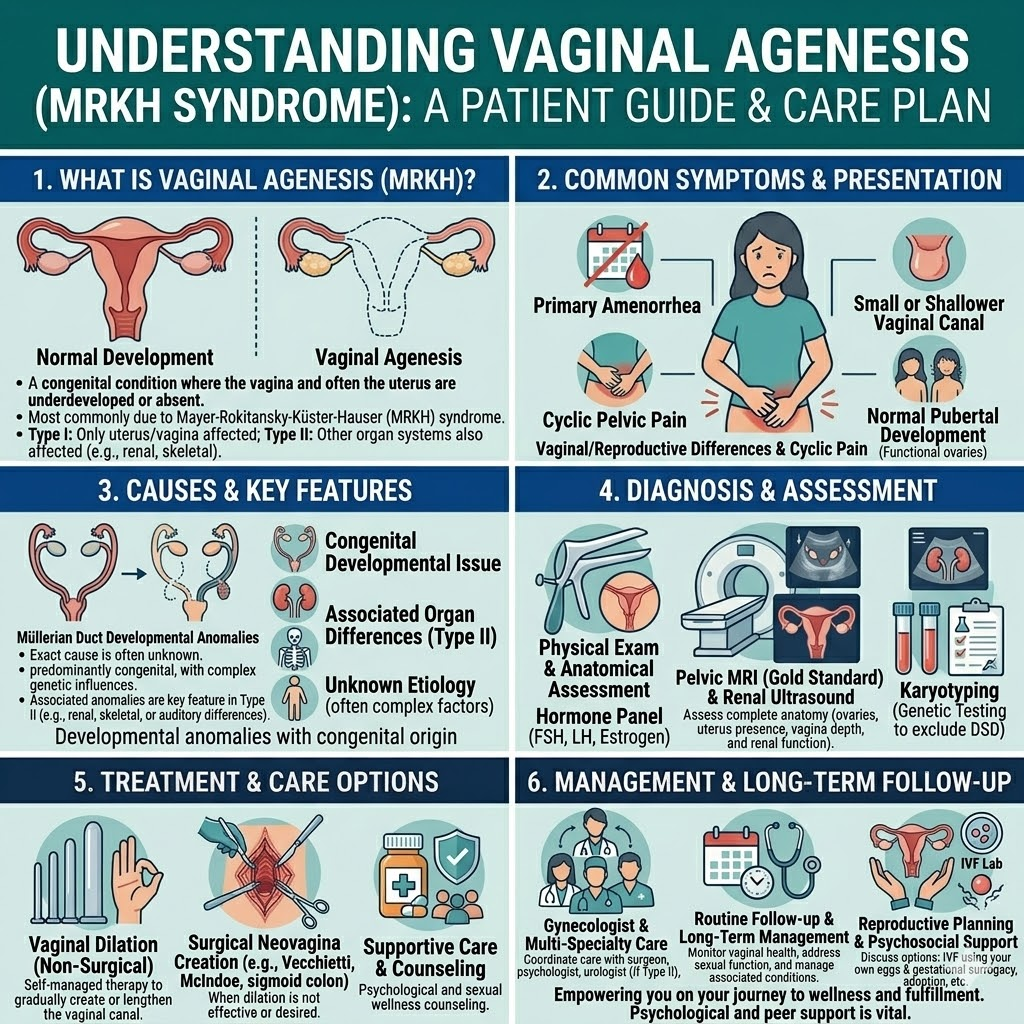
Vaginal agenesis is a rare condition present from birth where the vagina does not fully develop, or may be completely absent. The womb (uterus) may also be partially developed or missing. This condition is also known by other medical terms like mullerian agenesis or Mayer-Rokitansky-Kuster-Hauser syndrome. It is often discovered during the teenage years when a female does not begin menstruating. While the external genitals typically appear normal, internal reproductive organs are affected. Vaginal agenesis can also be associated with other developmental issues, such as problems with the kidneys or bones. Treatment options, including non-surgical methods like dilator use or surgical creation of a vagina, aim to allow for sexual activity.
Understanding the Condition
Vaginal Agenesis: Understanding a Rare Congenital Condition
Understanding the Condition
Common Symptoms
Absence of Menstruation: The most common and often first noticeable symptom is when a female does not start having menstrual periods (amenorrhea) by her teenage years, while other signs of puberty develop typically.
Normal External Genitalia: The external genital organs, such as the labia and clitoris, typically appear normal and fully developed.
Internal Reproductive Organ Differences: The vagina may be much shorter than usual, or entirely absent, sometimes appearing only as a shallow indentation where the vaginal opening would normally be. The cervix, which connects the vagina to the uterus, is often missing. The uterus may be absent or only partially developed. If there is uterine tissue lining (endometrium), monthly cramping or ongoing abdominal pain can occur.
Ovarian and Fallopian Tube Status: Typically, the ovaries are fully developed and functional, though they might be located in an unusual position within the abdomen. The fallopian tubes, which carry eggs from the ovaries, may sometimes be absent or not develop normally.
Associated Developmental Issues: Vaginal agenesis can be linked to other health concerns, including developmental problems with the kidneys and urinary tract, changes in the bones of the spine, ribs, and wrists, or, less commonly, hearing difficulties and other congenital conditions affecting the heart, digestive system, and limb growth.
Consultation Guide
Which Specialist to Meet
You may need to consult with several specialists. These include a gynecologist (a doctor specializing in female reproductive health), a reproductive endocrinologist (for hormone and fertility concerns), a urologist or nephrologist (for kidney and urinary tract issues), an orthopedic specialist (for bone problems), a geneticist (to discuss potential genetic factors), and a psychologist or counselor (for emotional support).
Preparations Before Your Visit
Before your visit, it's helpful to write down all your symptoms, including when they started. Prepare a list of your complete medical history, any medications or supplements you take, and any relevant family medical history. Also, write down any questions you have for the doctor to ensure all your concerns are addressed.
Book a doctor visit near me
Consultation Guide
Blood tests may be conducted to measure hormone levels and to rule out other medical conditions that could cause a lack of menstruation.
A small sample of blood will be drawn from a vein, typically in your arm. This is a routine procedure that causes a brief moment of discomfort when the needle is inserted. The sample is then sent to a lab for analysis.
Diagnostic Procedures
A physical exam is often the first step to assess the external genitals and to check for the presence and length of the vagina.
What to Expect
During the examination, your doctor will gently examine your external genital area. They may use a small, soft instrument to check for the presence of a vaginal opening and to assess the depth of the vaginal canal, if present. This is typically a brief and non-invasive part of the diagnostic process.
This imaging test uses sound waves to create pictures of your internal reproductive organs, such as the uterus, ovaries, and also to check the kidneys.
What to Expect
You will lie on an examination table. A gel will be applied to your lower abdomen, and a small handheld device (transducer) will be moved over the area to capture images. In some cases, particularly for adolescents, a transrectal ultrasound may be performed, where a thin transducer is gently inserted into the rectum to get clearer images of the pelvic organs. This procedure is generally not painful but can involve some pressure.
Magnetic Resonance Imaging (MRI)
An MRI provides highly detailed images of the reproductive organs, kidneys, and skeletal structures, offering a more comprehensive view than ultrasound.
What to Expect
You will lie still on a narrow table that slides into a large, tunnel-like machine. The MRI machine uses powerful magnets and radio waves to create images. It can be quite noisy, so you will usually be offered earplugs or headphones. The procedure is non-invasive, but you will need to remain still for a period, which can sometimes be up to an hour or longer. You will be able to communicate with the technician throughout the scan.
What to Expect
Genetic Testing / Karyotyping
If recommended, genetic testing or karyotyping can examine your chromosomes to identify any underlying genetic factors.
What to Expect
Similar to standard blood tests, a blood sample will be taken from your arm. Alternatively, a cheek swab may be used to collect cells. This sample is then analyzed to create a 'map' of your chromosomes, looking for any abnormalities.
Kidney and Urinary Tract Imaging
As kidney problems can be associated with vaginal agenesis, specific imaging tests like a kidney ultrasound might be performed to check their development and function.
What to Expect
This is similar to a pelvic ultrasound. Gel will be applied to your back or abdomen over the kidney area, and a handheld device will be moved over the skin to produce images of your kidneys and urinary tract. It is a painless and quick procedure.
Treatment Options
Procedures and Therapies
Vaginal Dilator Use: This non-surgical method involves using a series of smooth, rigid, tube-like devices (dilators) of increasing sizes. These are gently pressed against the indentation or short vagina over time to gradually stretch and create a functional vaginal canal. This method relies on existing pelvic tissues to form the new canal. (Duration: Requires consistent, daily use for several months to typically one to two years, with ongoing maintenance as needed.)
Vaginoplasty (Surgical Creation of a Vagina): For individuals where dilator therapy is unsuccessful or not preferred, surgery can create a vagina. Various surgical techniques exist, often involving using skin grafts from other parts of the body, or sometimes a segment of bowel, to line a newly created canal between the rectum and bladder. (Duration: Typically a single surgical procedure, followed by a recovery period. Dilator use is often recommended post-surgery for several months to maintain the width and depth of the newly created vagina.)
In Vitro Fertilization (IVF) with Gestational Carrier: While a missing or underdeveloped uterus prevents a woman from carrying a pregnancy, if she has healthy, functional ovaries, eggs can be collected and fertilized in a laboratory. The resulting embryo can then be implanted into the uterus of another person (a gestational carrier) to carry the pregnancy to term. (Duration: The process involves several weeks for egg retrieval and fertilization, followed by the gestational carrier's pregnancy term (approximately 9 months).)
Counseling and Psychological Support: Living with vaginal agenesis can have significant emotional and psychological impacts. Counseling, either individual or in support groups, can help individuals cope with feelings about body image, self-esteem, sexual health, and fertility challenges. (Duration: As needed, ranging from short-term to ongoing support.)
Pelvic Health Maintenance: If a vagina has been created through dilator use or surgery, ongoing care and potential dilator use may be necessary to maintain its patency (openness) and ensure its continued health and functionality.
Emotional and Psychological Support
Seek Support Groups: Connecting with others who have vaginal agenesis can provide a sense of community, shared understanding, and valuable peer support, reducing feelings of isolation.
Consult Mental Health Professionals: Therapists or counselors specializing in sexual health or chronic conditions can help process emotions related to body image, self-esteem, intimacy, and fertility concerns, offering coping strategies.
Open Communication with Partners: Fostering open and honest communication with sexual partners about the condition and its implications can build trust and understanding, leading to a more fulfilling sexual experience.
Education on Personal Sexual Function: Learning about one's own body and how it functions sexually after treatment for vaginal agenesis can empower individuals to explore and enjoy intimacy.
Reproductive Planning
Fertility Counseling: If family building is a goal, consult with a fertility specialist to discuss all available options, including in vitro fertilization with a gestational carrier, adoption, or other paths to parenthood.
Prevention & Long-Term Wellbeing
Long-Term Monitoring
Regular Medical Check-ups: Maintain regular visits with your healthcare provider to monitor overall health and address any associated conditions, such as kidney or skeletal issues, that may be present.
Tags & Topics
Notice an error or need an update?
Help us keep medical information accurate. Report incorrect info or suggest an edit.


