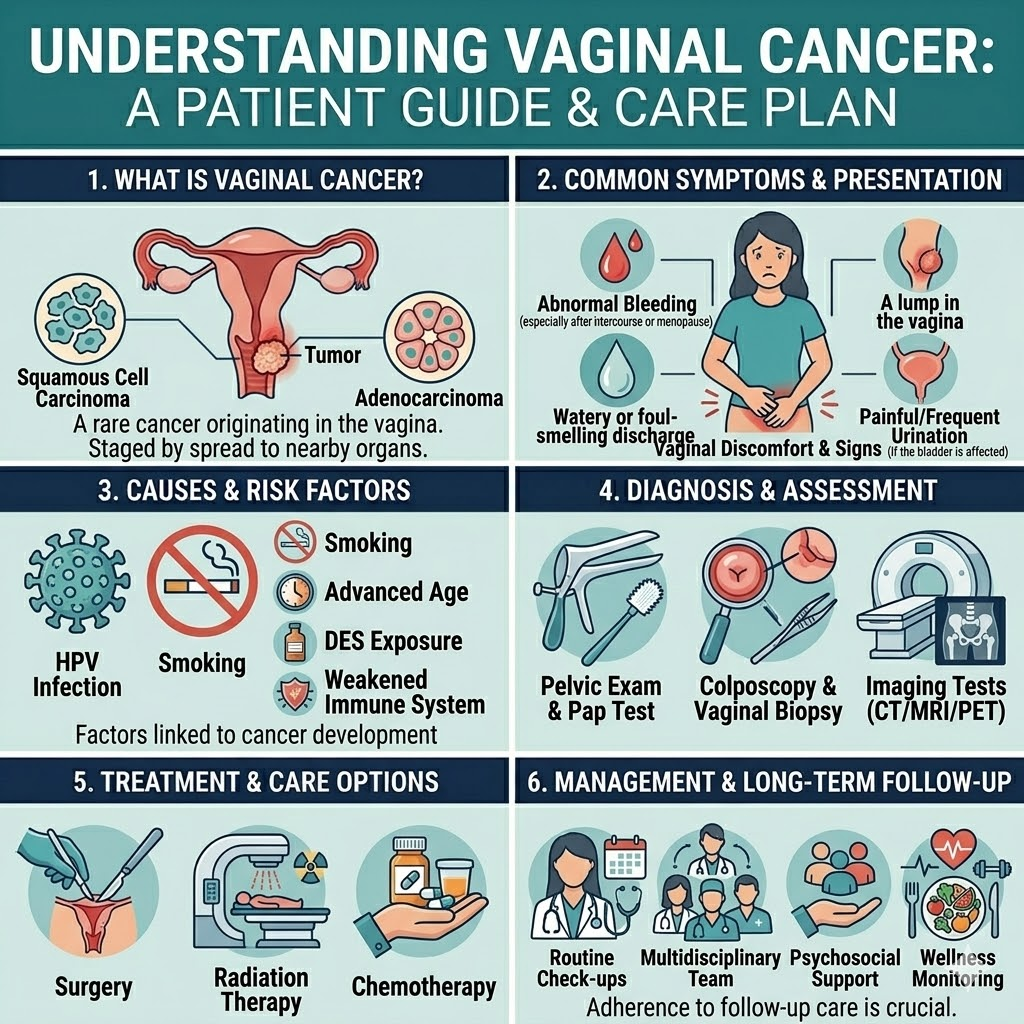
Vaginal cancer is a rare condition where abnormal cells begin to grow rapidly in the vagina, the muscular tube connecting the uterus to the outside of the body (also known as the birth canal). These fast-growing cells can spread and harm healthy tissues. Most cancers found in the vagina actually start elsewhere in the body and then spread to the vagina. When vaginal cancer is found and treated early, while still confined to the vagina, the chances for a successful cure are significantly higher. If it spreads beyond the vagina, treatment becomes much more challenging.
Understanding the Condition
Vaginal Cancer: Understanding Symptoms, Diagnosis, and Care
Understanding the Condition
Common Symptoms
Unusual Vaginal Bleeding: Bleeding after menopause, after sexual intercourse, or at times not typical for your menstrual cycle.
Vaginal Discharge: Any unusual discharge that is not typical for you.
Vaginal Lump or Mass: Feeling a growth or thickening in the vagina.
Painful Urination: Discomfort or pain when passing urine.
Frequent Urination: Need to urinate more often than usual.
Constipation: Difficulty or infrequent bowel movements.
Pelvic Pain: Pain or discomfort in the lower belly area.
Consultation Guide
Which Specialist to Meet
Before your appointment, be ready to discuss all your symptoms, including when they started and how they affect you. Write down any medications you take, your medical history, and any questions you have for your doctor. Be prepared for a physical examination, which may include a pelvic exam.
Book a doctor visit near me
Palliative Care: Specialized medical care focused on providing relief from the pain and other symptoms of a serious illness, as well as managing side effects from medical treatments. It aims to improve quality of life for both the patient and their family. (Duration: Ongoing, for as long as needed alongside curative treatments.)
Symptom Awareness: Be vigilant about any new or returning symptoms, and report them promptly to your doctor. Early detection of recurrence or new problems improves treatment outcomes.
Consultation Guide
You will lie on an exam table. The doctor visually inspects outer genitals, then uses gloved hands to gently feel internal organs. A speculum may be used to view the cervix, which might cause pressure.
A speculum holds the vagina open while a small brush and device collect cervical cells. This may cause mild pressure or a brief scraping sensation.
HPV Vaccination: Getting vaccinated against human papillomavirus (HPV) can significantly lower your risk of certain HPV-related cancers, including some types of vaginal cancer, as HPV is a major cause.
Diagnostic Procedures
You should initially consult with your primary care provider or a gynecologist (a doctor specializing in female reproductive health). Depending on the diagnosis, you may be referred to an oncologist (a cancer specialist), a radiation oncologist (specializing in radiation therapy for cancer), or a surgical oncologist (a surgeon specializing in cancer removal).
Preparations Before Your Visit
A physical examination of your reproductive organs (vulva, vagina, cervix, uterus, ovaries) and rectum to check for abnormalities.
What to Expect
Collects cells from the cervix for microscopic examination to screen for cervical cancer and sometimes detect signs of vaginal cancer.
What to Expect
A magnified view of the cervix, vagina, and vulva to examine suspicious areas, often after an abnormal Pap test.
What to Expect
Similar to a pelvic exam, a colposcope (magnifying instrument) is used. A solution might be applied to highlight abnormal cells. A small tissue sample (biopsy) may be taken, causing a mild pinch or cramp.
Removal of a small tissue sample from a suspicious area using a needle for laboratory testing to diagnose cancer.
What to Expect
After local numbing, a thin needle is guided into the target tissue, often with imaging guidance. You may feel pressure, but the anesthetic minimizes pain.
CT Scan (Computed Tomography Scan)
Uses X-rays and computer processing to create detailed cross-sectional images of bones, blood vessels, and soft tissues.
What to Expect
You lie on a table that slides into a large scanner. You must remain still for several minutes. A contrast dye may be injected to enhance image clarity.
PET Scan (Positron Emission Tomography Scan)
An imaging test using a radioactive tracer to show metabolic activity, helping detect diseases like cancer by highlighting areas of high activity.
What to Expect
A tracer is injected, and after circulation, you lie still in a scanner for about 30 minutes. The scan is painless. Often combined with a CT or MRI.
A rapid, painless imaging test using radiation to produce pictures of internal body structures, particularly bones.
What to Expect
You will be positioned by a technician, and an X-ray machine will capture images. You might be asked to hold your breath briefly. The actual exposure is very short.
A procedure to visually examine the lining of the bladder and urethra using a thin, lighted tube with a camera (cystoscope).
What to Expect
The urethra is numbed. The cystoscope is gently inserted. You may feel pressure or an urge to urinate. Sedation or anesthesia might be used for longer procedures.
Regular Screenings and Exams: Routine pelvic exams and Pap tests, primarily for cervical cancer screening, can sometimes detect early signs of vaginal cancer or precancerous changes. Discuss recommended frequency with your provider.
Avoiding Tobacco Products: Smoking tobacco increases the risk of various cancers, including vaginal cancer. Quitting smoking can help reduce this risk.
Follow-Up Appointments: Regular check-ups with your healthcare team after treatment are crucial to monitor for any signs of cancer recurrence or new issues. These appointments may include physical exams and imaging tests.
Treatment Options
Vaginal cancer is a rare condition where abnormal cells begin to grow rapidly in the vagina, the muscular tube connecting the uterus to the outside of the body (also known as the birth canal). These fast-growing cells can spread and harm healthy tissues. Most cancers found in the vagina actually start elsewhere in the body and then spread to the vagina. When vaginal cancer is found and treated early, while still confined to the vagina, the chances for a successful cure are significantly higher. If it spreads beyond the vagina, treatment becomes much more challenging.
Surgical Procedures
Tumor Removal Surgery: A surgical procedure to remove the cancerous tumor and some surrounding healthy tissue. The extent of surgery depends on the size and location of the cancer. (Duration: Varies based on the extent of surgery and recovery, typically days for hospital stay, weeks for full recovery.)
External Beam Radiation Therapy: Uses high-energy beams, often X-rays, directed from a machine outside your body to precisely target and kill cancer cells. (Duration: Typically given over several weeks, usually five days a week, for a few minutes per session.)
Brachytherapy (Internal Radiation): Involves placing radioactive material directly inside or very close to the tumor. This delivers a higher dose of radiation directly to the cancer while minimizing harm to surrounding healthy tissues. (Duration: Can involve temporary implants (left in for minutes to days) or permanent implants (gradually losing radioactivity over months). Overall treatment time is often shorter.)
Medications
Chemotherapy: Uses powerful drugs, often given intravenously (through a vein) or orally, to kill fast-growing cancer cells throughout the body. Can be used alone or with other treatments. (Duration: Administered in cycles over several weeks or months, with rest periods between cycles.)
Prevention & Long-Term Wellbeing
Prevention
Awareness of DES Exposure: If your mother took the drug diethylstilbestrol (DES) during her pregnancy with you, you may have an increased risk of a rare type of vaginal cancer. Discuss your medical history with your doctor.
Long-Term Monitoring
Healthy Lifestyle: Maintaining a balanced diet, regular physical activity, and managing stress can contribute to overall well-being and recovery.
Tags & Topics
Notice an error or need an update?
Help us keep medical information accurate. Report incorrect info or suggest an edit.


