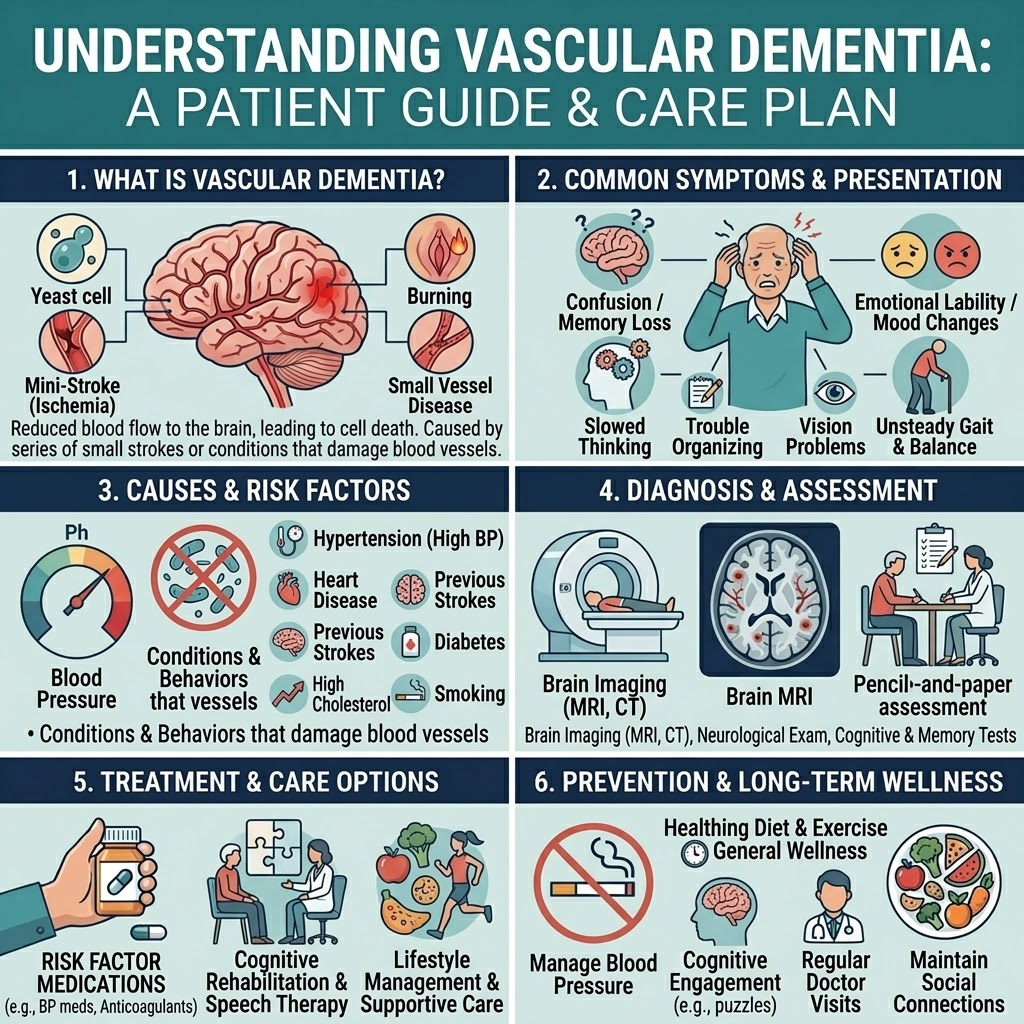
Vascular cognitive impairment (VCI) describes changes in thinking and memory caused by reduced blood flow to the brain. "Vascular" refers to blood vessels and circulation, while "cognitive impairment" means changes in how you think. VCI can affect language, decision-making, planning, and judgment. This condition exists on a spectrum, ranging from mild cognitive changes to more severe "vascular dementia." It often occurs after a stroke, which cuts off oxygen and nutrients to brain cells. However, not all strokes lead to VCI. Other conditions that damage blood vessels, such as uncontrolled diabetes, high blood pressure, and high cholesterol, can also contribute to VCI by reducing circulation. Managing these risk factors is crucial for prevention. The severity and type of VCI depend on where and how much the brain's blood flow is affected.
Understanding the Condition
Understanding Vascular Cognitive Impairment and Dementia
Understanding the Condition
Common Symptoms
Confusion: Difficulty understanding situations or surroundings, and disorientation.
Trouble Paying Attention or Focusing: Struggling to concentrate on tasks or conversations.
Reduced Ability to Organize Thoughts or Actions: Challenges with planning, sequencing tasks, or structuring ideas.
Problems with Decision-Making: Difficulty making choices or understanding consequences.
Problems with Memory: Forgetfulness, though often less prominent in early stages compared to speed of thinking.
Difficulties with Language: Trouble finding words or expressing thoughts clearly.
Changes in Gait: Alterations in how a person walks, often appearing unsteady.
Poor Balance: Increased risk of falls due to instability.
Urinary Issues: Sudden or frequent urges to urinate, or difficulty controlling bladder function.
Emotional or Mood Changes: Experiencing depression, apathy (lack of interest), or anxiety.
Consultation Guide
Which Specialist to Meet
You should consult your primary care physician first. They may refer you to specialists such as a neurologist (a doctor specializing in brain and nervous system disorders), a geriatrician (a doctor specializing in the health of older adults), or a neuropsychologist (a psychologist specializing in brain function and behavior).
Preparations Before Your Visit
Before your visit, prepare a detailed list of your symptoms, including when they started and how they affect your daily life. Bring a list of all medications you are currently taking, including over-the-counter drugs and supplements. Be ready to discuss your medical history, any recent illnesses or injuries, and your family's medical history regarding neurological conditions. Consider bringing a family member or close friend for support and to help recall details.
Book a doctor visit near me
Consultation Guide
Vascular cognitive impairment (VCI) describes changes in thinking and memory caused by reduced blood flow to the brain. "Vascular" refers to blood vessels and circulation, while "cognitive impairment" means changes in how you think. VCI can affect language, decision-making, planning, and judgment. This condition exists on a spectrum, ranging from mild cognitive changes to more severe "vascular dementia." It often occurs after a stroke, which cuts off oxygen and nutrients to brain cells. However, not all strokes lead to VCI. Other conditions that damage blood vessels, such as uncontrolled diabetes, high blood pressure, and high cholesterol, can also contribute to VCI by reducing circulation. Managing these risk factors is crucial for prevention. The severity and type of VCI depend on where and how much the brain's blood flow is affected.
A comprehensive assessment to evaluate your brain, spinal cord, nerves, and muscles. It helps your healthcare team identify nervous system conditions and their causes.
This routine test measures the pressure in your arteries as your heart pumps blood. High blood pressure is a significant risk factor for vascular problems affecting the brain.
You will lie on a narrow table that slides into a large, donut-shaped machine. The table moves slowly through the scanner as images are taken. You may be asked to hold your breath briefly at times. Sometimes, a contrast dye is injected into a vein to highlight specific areas, which might cause a brief warm flush or metallic taste. The scan is typically quick, often taking only a few minutes.
This procedure uses sound waves to visualize blood flow through the carotid arteries, which are major blood vessels in your neck that supply blood to your brain. It checks for narrowing or blockages caused by plaque buildup, a common cause of stroke.
Regular Health Check-ups: Consistent monitoring by a doctor to track blood pressure, cholesterol, and blood sugar levels, ensuring early detection and management of risk factors.
Diagnostic Procedures
Neurological Examination
What to Expect
A doctor, often a neurologist, will ask about your medical history and perform various tests. These may include checking your reflexes, balance, coordination, muscle strength, sensation, vision, hearing, and mental status (memory, problem-solving, attention). The exam can take from a few minutes to over an hour.
What to Expect
A healthcare professional will place an inflatable cuff around your upper arm. The cuff will tighten for a few seconds as it inflates, which some people find slightly uncomfortable, then slowly deflate. Two numbers are recorded: the top number (systolic) when your heart beats, and the bottom number (diastolic) when your heart rests between beats.
Brain Magnetic Resonance Imaging (MRI)
A diagnostic imaging test that provides highly detailed pictures of the brain, spinal cord, and surrounding structures using powerful magnets and radio waves. It helps identify areas of damage, such as from strokes or blood vessel changes.
What to Expect
You will lie on a movable table that slides into a large, tube-shaped machine. The machine makes loud knocking or buzzing noises, so you may be offered earplugs or headphones. You must remain very still during the scan, which can last 30 to 60 minutes or longer. Some people feel anxious in enclosed spaces; inform your doctor if this is a concern. The test does not use radiation.
CT Scan (Computed Tomography Scan)
An imaging test that uses X-rays and computer processing to create detailed cross-sectional images, or 'slices,' of the brain. It can quickly detect signs of stroke, bleeding, or other structural changes.
What to Expect
What to Expect
You will lie on your back while a technician applies a gel to your neck. A small handheld device called a transducer is then pressed against your skin and moved over the carotid arteries. You might hear whooshing sounds as the blood flow is detected. The test is painless and usually takes about 15-30 minutes.
Treatment Options
Medications
Blood Pressure Lowering Medications: Prescription drugs to reduce high blood pressure, thereby lessening strain on blood vessels. (Duration: Long-term, as prescribed by your doctor)
Cholesterol Lowering Medications: Drugs to reduce harmful cholesterol levels and prevent plaque buildup in arteries. (Duration: Long-term, as prescribed by your doctor)
Blood Thinners or Antiplatelet Agents: Medications to prevent blood clots, especially after a stroke or if at high risk. (Duration: Long-term, as prescribed by your doctor)
Diabetes Medications: Drugs or insulin to manage blood sugar levels and prevent vascular complications of diabetes. (Duration: Long-term, as prescribed by your doctor)
Procedures and Therapies
Angioplasty and Stenting: A procedure to widen narrowed arteries using a balloon and often placing a small mesh tube (stent) to keep the artery open. (Duration: Single procedure, followed by recovery and ongoing medication)
Cognitive Rehabilitation: Therapies focused on improving memory, attention, problem-solving, and other cognitive skills. (Duration: Varies, typically weeks to months, or ongoing as needed)
Physical, Occupational, and Speech Therapy: Rehabilitation to regain physical strength, coordination, daily living skills, and communication abilities after a stroke. (Duration: Varies, typically weeks to months, or ongoing as needed)
Surgical Procedures
Manage Chronic Conditions: Diligently follow treatment plans for conditions like high blood pressure, diabetes, and high cholesterol to prevent vascular damage.
Cognitive Stimulation: Engaging in mentally challenging activities, such as reading, puzzles, learning new skills, and social interaction, to support brain health.
Social Engagement: Staying connected with friends, family, and community groups to reduce isolation and promote mental well-being.
Stress Management: Practicing relaxation techniques like meditation, deep breathing, or yoga to manage stress, which can impact overall health.
Monitoring and Support: Regular follow-up appointments with healthcare providers, consistent medication adherence, and seeking support from family or support groups to navigate living with VCI.
Prevention & Long-Term Wellbeing
Lifestyle Management
Blood Pressure Control: Adopting a low-sodium diet, regular exercise, and maintaining a healthy weight to lower blood pressure. (Duration: Ongoing and lifelong)
Cholesterol Management: Consuming a heart-healthy diet low in saturated and trans fats, rich in fruits, vegetables, and whole grains. (Duration: Ongoing and lifelong)
Blood Sugar Control: Following a balanced diet, exercising regularly, and monitoring blood glucose levels, especially for individuals with diabetes. (Duration: Ongoing and lifelong)
Smoking Cessation: Quitting smoking immediately and completely to reduce vascular damage. (Duration: Lifelong abstinence)
Carotid Endarterectomy: A surgical procedure to remove plaque buildup from inside the carotid arteries in the neck, restoring blood flow to the brain. (Duration: Single procedure, followed by a recovery period of several weeks to months)
Prevention
Heart-Healthy Diet: Adopting a diet rich in fruits, vegetables, whole grains, lean proteins, and healthy fats, while limiting processed foods, unhealthy fats, and excessive sugar/salt.
Regular Physical Activity: Engaging in at least 150 minutes of moderate-intensity aerobic exercise or 75 minutes of vigorous-intensity exercise per week, combined with muscle-strengthening activities.
Avoid Tobacco Use: Completely stopping all forms of tobacco use, including smoking and vaping, to protect blood vessel health.
Sufficient Sleep: Aiming for 7-9 hours of quality sleep per night, as adequate rest is vital for brain function and recovery.
Tags & Topics
Notice an error or need an update?
Help us keep medical information accurate. Report incorrect info or suggest an edit.


