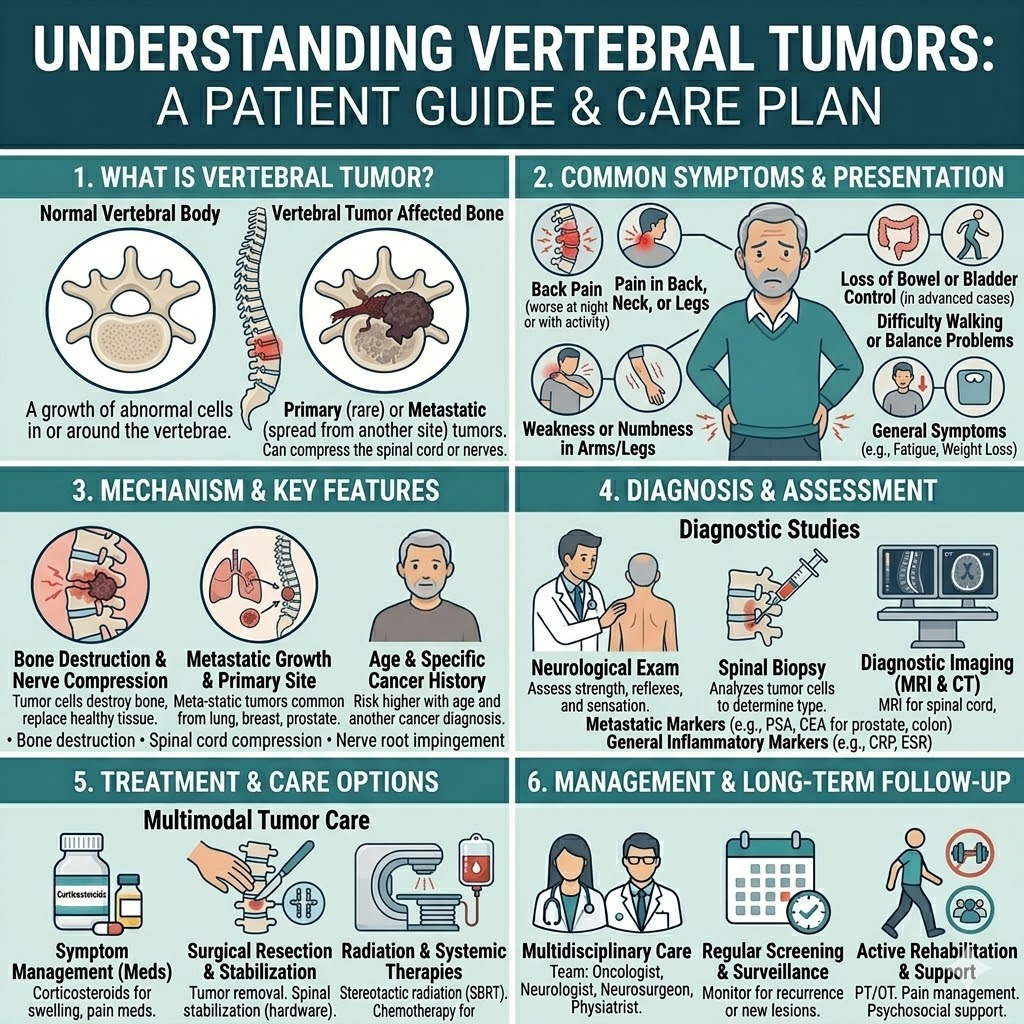
A vertebral tumor is an abnormal growth of cells within the bones of your spine, called vertebrae. These growths can be non-cancerous (benign) or cancerous (malignant). Most malignant spinal tumors originate from cancer that has spread from another part of the body (metastatic cancer). Less commonly, a tumor starts directly in the spine bones (primary bone tumor). These growths can press on the spinal cord or nerves, causing various symptoms. Treatment depends on the tumor's type, whether it is cancerous, and its location.
Understanding the Condition
Spinal Tumors: Understanding Growths in Your Spine
Understanding the Condition
A vertebral tumor is an abnormal growth of cells within the bones of your spine, called vertebrae. These growths can be non-cancerous (benign) or cancerous (malignant). Most malignant spinal tumors originate from cancer that has spread from another part of the body (metastatic cancer). Less commonly, a tumor starts directly in the spine bones (primary bone tumor). These growths can press on the spinal cord or nerves, causing various symptoms. Treatment depends on the tumor's type, whether it is cancerous, and its location.
Common Symptoms
Localized Back Pain: Back pain near the tumor site, often radiating or shooting to nearby areas, and worse at night.
Sensory Changes: Changes in sensation like numbness, tingling, or a 'pins and needles' feeling.
Motor Weakness or Paralysis: Difficulty moving a part of your body, or complete loss of movement.
Bladder and Bowel Dysfunction: Loss of control over bladder or bowel functions.
Muscle Weakness: Generalized weakness in your muscles.
Important Note on Back Pain: While back pain is common and usually not caused by a tumor, persistent or worsening symptoms, especially with neurological changes, warrant medical evaluation.
Consultation Guide
Which Specialist to Meet
Your journey may start with your primary care doctor, who may refer you to a neurologist (a doctor specializing in the nervous system), an orthopedic surgeon (bone specialist), or an oncologist (cancer specialist). Depending on your situation, you might also see a radiation oncologist.
Preparations Before Your Visit
Before your appointment, it's helpful to write down all your symptoms, including when they started and how they affect your daily life. Make a list of all medications you're currently taking and any questions you have for the doctor. Be prepared to discuss your medical history.
Book a doctor visit near me
The doctor will ask about your medical history and symptoms. They will then perform a series of tests to check your mental status (e.g., memory, orientation), reflexes, balance, coordination, muscle strength, and sensation (e.g., touch, temperature). This involves simple tasks like walking, touching your nose, or following a finger with your eyes. The exam can take from a few minutes to over an hour, depending on your symptoms.
Watchful Waiting (Observation): For small, non-cancerous, or slow-growing tumors that are not causing symptoms, your healthcare team might recommend closely monitoring the tumor with regular check-ups and imaging scans rather than starting immediate treatment. (Duration: Ongoing, with regular follow-up appointments and scans.)
Pain Management and Physical Therapy: These therapies focus on managing symptoms like pain and weakness. Physical therapy can help improve strength, flexibility, and mobility, while various medications can help control pain. (Duration: As needed, potentially ongoing for long-term symptom management.)
Healthy Lifestyle and Early Cancer Detection: While the causes of primary spinal tumors are not fully understood, maintaining a healthy lifestyle (balanced diet, regular exercise, avoiding smoking) supports general health. Since most malignant spinal tumors spread from elsewhere, regular check-ups and promptly addressing new symptoms for early cancer detection are crucial.
Ongoing Monitoring and Symptom Support: Regular follow-up appointments and imaging scans are vital post-treatment to detect recurrence. Physical and occupational therapy, along with pain management, help regain function and manage symptoms. Emotional support from professionals or support groups also plays a key role in coping.
Diagnostic Procedures
CT Scan (Computed Tomography Scan)
A CT scan uses specialized X-ray equipment and a computer to create detailed cross-sectional images, or 'slices,' of bones, blood vessels, and soft tissues inside your body, offering more detail than a standard X-ray.
What to Expect
You will lie on a movable table that slides into a large, donut-shaped machine. The scanner will rotate around you, taking images. You might hear whirring or clicking noises. Sometimes, a contrast dye is given orally or injected to make certain areas show up more clearly. The procedure is generally painless and takes 10-30 minutes.
This procedure involves inserting a thin needle through your skin and into the suspicious area to collect a small sample of cells or tissue. The sample is then sent to a lab to be examined under a microscope for signs of cancer or other conditions.
What to Expect
You will lie down, and the skin over the biopsy site will be cleaned and numbed with a local anesthetic. The doctor will use imaging guidance (like CT or ultrasound) to precisely guide the needle. You might feel some pressure or a brief sting as the needle enters, but it should not be overly painful. The procedure usually takes about 15-30 minutes, and you may experience some soreness afterward.
Neurological Examination
A neurological exam is a physical assessment designed to check how well your brain, spinal cord, nerves, and muscles are working. It helps doctors identify problems within your nervous system.
What to Expect
Treatment Options
Anti-Cancer Medication (Chemotherapy): Chemotherapy uses powerful medications, usually given intravenously or orally, to kill rapidly growing cells, including cancer cells throughout the body. It's often used for widespread cancer or specific tumor types. (Duration: Administered in cycles over several weeks or months, depending on the specific regimen and tumor response.)
Surgical Procedures
Tumor Resection: Surgery aims to remove the tumor, either completely or partially, to relieve pressure on the spinal cord and nerves. The extent of surgery depends on the tumor's size, type, and location. (Duration: A single procedure, with recovery time varying from weeks to months depending on complexity.)
Targeted Radiation Therapy: This treatment uses high-energy beams, often X-rays, to kill cancer cells or shrink tumors. It can be delivered externally (from a machine outside the body) or internally (with a small implant placed near the tumor). (Duration: Typically administered daily for several weeks for external beam, or as a single session for internal implants, depending on the type and location of the tumor.)
Highly Focused Radiation (Stereotactic Radiosurgery - SRS): SRS is a non-surgical technique that delivers very precise, high doses of radiation beams to the tumor, minimizing damage to surrounding healthy tissue. It's especially useful for tumors in the brain or spine. (Duration: Often completed in a single session for brain and spine tumors, or 3-5 sessions for tumors in other body areas.)
Supportive and Complementary Therapies
Acupuncture: Acupuncture involves inserting very thin needles into specific points on the body. While not a primary treatment for tumors, it is often used as a complementary therapy to help manage pain and improve overall well-being, particularly for discomfort associated with tumors or treatment side effects. (Duration: Multiple sessions over weeks or months, depending on individual needs and response.)
Prevention & Long-Term Wellbeing
Prevention
Tags & Topics
Notice an error or need an update?
Help us keep medical information accurate. Report incorrect info or suggest an edit.


