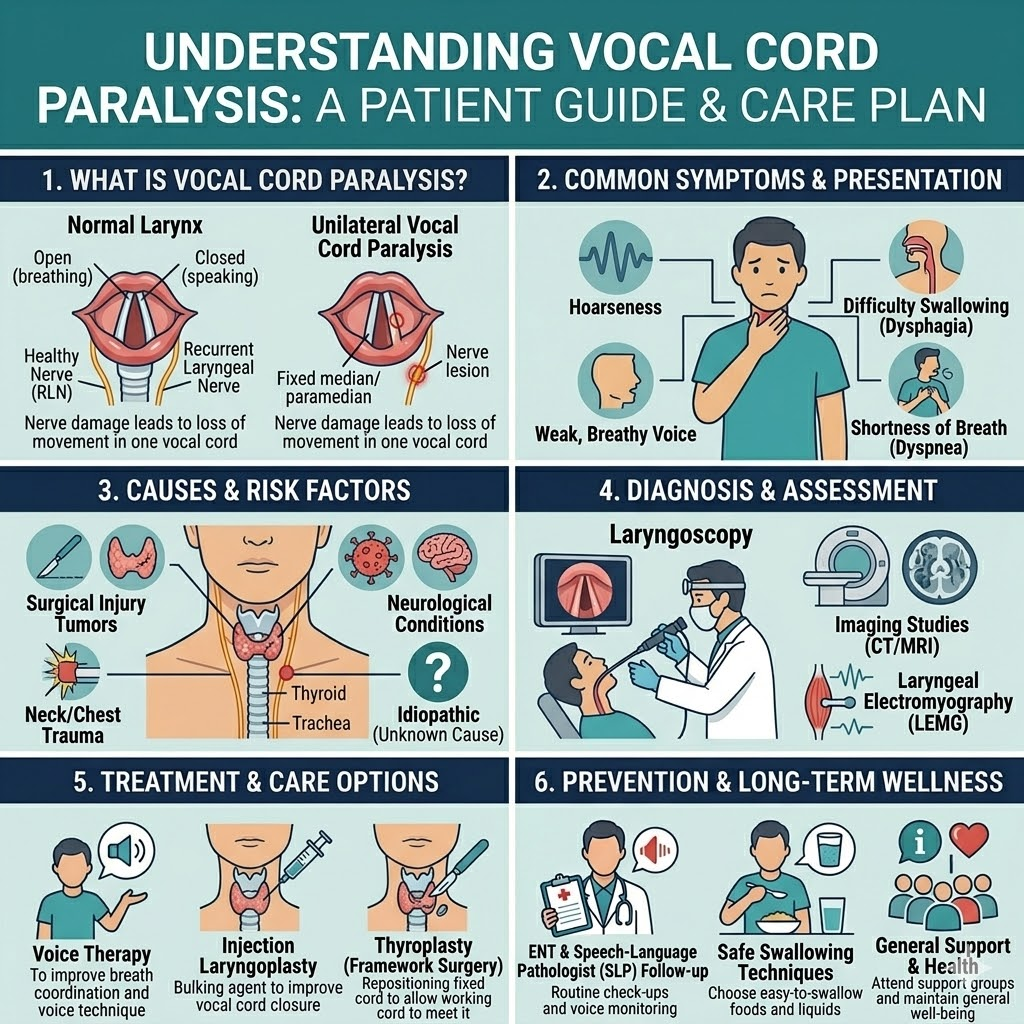
Vocal cord paralysis occurs when nerve signals to the voice box, or larynx, are disrupted, causing loss of control over the muscles that move the vocal cords. These two flexible bands of muscle tissue, also known as vocal folds, are crucial for both sound production and protecting your airway. They come together and vibrate to make your voice, and stay open for breathing. When paralyzed, they cannot move properly, leading to difficulties with speaking, breathing, and swallowing. This condition can stem from various causes, including nerve damage from surgery or injury, viral infections, certain cancers, stroke, or neurological disorders.
Understanding the Condition
Vocal Cord Paralysis: Understanding Your Voice and Breathing
Understanding the Condition
Common Symptoms
Breathy Voice: Your voice may sound airy, as if air is escaping while you speak.
Hoarseness: A rough, raspy, or strained quality to your voice.
Noisy Breathing: Labored breathing that creates noticeable sound.
Shortness of Breath: Feeling winded or unable to get enough air, especially with exertion.
Loss of Vocal Pitch: Difficulty controlling the highness or lowness of your voice.
Choking or Coughing During Swallowing: Food, drink, or saliva may enter the windpipe instead of the esophagus.
Frequent Breaths While Speaking: Needing to pause often to take a breath mid-sentence.
Inability to Speak Loudly: Struggling to project your voice or make it heard.
Loss of Gag Reflex: Reduced or absent protective reflex to prevent choking.
Ineffective Coughing: A weak cough that doesn't clear the throat well.
Frequent Throat Clearing: A persistent sensation of needing to clear your throat.
Consultation Guide
Which Specialist to Meet
Before your visit, make a detailed list of your symptoms, including when they started and how they affect your daily life. Prepare a list of all medications, vitamins, and supplements you currently take, along with any existing medical conditions or recent illnesses. Be ready to discuss your medical history, including any past surgeries or traumas. Bringing a family member or friend for support and to help take notes can also be helpful. Prepare any questions you have for the doctor.
Book a doctor visit near me
Vocal Rest: Limiting voice use and avoiding shouting or excessive talking can help reduce strain on your vocal cords. (Duration: As recommended by your doctor or therapist, often for short periods during recovery or symptom flares.)
Consultation Guide
Vocal cord paralysis occurs when nerve signals to the voice box, or larynx, are disrupted, causing loss of control over the muscles that move the vocal cords. These two flexible bands of muscle tissue, also known as vocal folds, are crucial for both sound production and protecting your airway. They come together and vibrate to make your voice, and stay open for breathing. When paralyzed, they cannot move properly, leading to difficulties with speaking, breathing, and swallowing. This condition can stem from various causes, including nerve damage from surgery or injury, viral infections, certain cancers, stroke, or neurological disorders.
You should consult with an Ear, Nose, and Throat (ENT) doctor, also known as an otolaryngologist, who specializes in conditions of the voice box. Depending on the suspected cause, a neurologist (nerve specialist) may also be involved. A speech-language pathologist can provide voice therapy.
Preparations Before Your Visit
Tracheotomy: For severe breathing difficulties, especially with paralysis of both vocal cords, a surgical opening is created in the windpipe (trachea) to provide an alternative airway. (Duration: Can be a temporary measure or a permanent solution, depending on the underlying cause and patient recovery.)
Anti-inflammatory Medications: If inflammation is contributing to nerve damage or vocal cord swelling, these medications may be used to reduce it. (Duration: Short-term use, as prescribed by your doctor, depending on the severity and cause of inflammation.)
Antiviral or Antibiotic Medications: If a specific viral or bacterial infection is identified as the cause of nerve damage, these medications are prescribed to treat the infection. (Duration: Follow the full course of treatment as prescribed by your doctor, typically days to weeks.)
Home Remedies & Supportive Care
Diagnostic Procedures
CT Scan (Computerized Tomography Scan)
A CT scan uses specialized X-ray equipment and computer processing to create detailed cross-sectional images, or 'slices,' of your bones, blood vessels, and soft tissues. For vocal cord paralysis, it can help identify tumors, injuries, or other structural issues in your neck or chest that might be affecting the nerves to your voice box.
What to Expect
You will lie on a motorized table that slides into a large, donut-shaped scanner. You may receive a contrast dye, either by injection or orally, to highlight certain areas. It's important to remain still during the scan, which typically takes a few minutes. The process is painless, though some people find the enclosed space uncomfortable.
Electromyography (EMG)
EMG is a test that evaluates the health of your muscles and the nerves that control them. It measures the electrical activity of muscle fibers to determine if there is nerve damage causing muscle weakness or paralysis, specifically to the vocal cord muscles.
What to Expect
The procedure has two parts. For the needle EMG, tiny, thin needles (electrodes) are gently inserted into the vocal cord muscles. You might feel a brief pinprick sensation. These electrodes record the electrical activity. For the nerve conduction study, sticky patches (surface electrodes) are placed on your skin. Small electrical pulses are sent through the nerves, and the electrodes measure how quickly and strongly the signals travel. This may feel like a mild tingling or shock.
An upper endoscopy involves a long, thin, flexible tube with a camera (endoscope) that is gently guided down your throat. This allows your doctor to visually examine the lining of your esophagus, stomach, and the beginning of your small intestine (duodenum) to look for any abnormalities, growths, or other conditions that might be impacting nearby nerves or structures related to your voice box.
What to Expect
You may receive a sedative to help you relax and a numbing spray for your throat. You'll lie on your side, and the endoscope will be carefully passed through your mouth and down your throat. You might feel some pressure, but it shouldn't be painful. The camera sends images to a monitor, allowing the doctor to inspect the area. The procedure usually takes 15-30 minutes, and you'll need someone to drive you home afterward due to the sedation.
An X-ray is a quick, painless imaging test that uses small amounts of radiation to create images of the structures inside your body, particularly bones. For vocal cord paralysis, a chest or neck X-ray can help identify obvious structural issues, such as large tumors or fractures, that could be impacting nerve pathways.
What to Expect
You will be asked to stand or lie in various positions. A technician will position you and may place lead shields over parts of your body not being X-rayed. You'll need to remain perfectly still for a few seconds while the X-ray is taken. The process is quick and generally takes only a few minutes.
Managing Underlying Conditions: Prompt diagnosis and effective treatment of infections, neurological conditions, or tumors can help prevent or mitigate vocal cord paralysis.
Protecting Against Injury: Taking precautions to avoid trauma to the neck and chest, such as wearing seatbelts and appropriate sports safety gear.
Long-Term Monitoring & Support
Treatment Options
Therapies
Voice Therapy: Working with a speech-language pathologist, you'll learn exercises to strengthen your voice, improve breath support, enhance vocal cord closure, and protect your airway from choking. This helps compensate for the paralyzed vocal cord. (Duration: Typically involves several sessions over weeks to months, with ongoing practice at home.)
Surgical Procedures
Vocal Cord Bulk Injection (Augmentation): A material (such as a body-safe filler) is injected into the paralyzed vocal cord to 'plump' it up. This moves it closer to the healthy vocal cord, allowing for better closure and stronger voice production. (Duration: Effects can be temporary (lasting months) or longer, depending on the injected material, and may require repeat injections.)
Thyroplasty (Vocal Cord Medialization): A small implant is placed within the voice box cartilage, pushing the paralyzed vocal cord towards the middle. This helps the vocal cords meet more effectively for speaking and swallowing. (Duration: A permanent solution, with immediate improvement in voice quality often observed.)
Vocal Cord Reinnervation: A healthy nerve from another part of the neck is carefully re-routed and connected to the paralyzed vocal cord muscle, aiming to restore nerve supply and muscle movement. (Duration: Results develop gradually over several months as the nerve regenerates and connects.)
Medications
Minimizing Surgical Risk: When undergoing surgeries near the neck or chest, experienced surgeons employ precise techniques to reduce the risk of nerve damage to the vocal cords.
Regular Medical Follow-ups: Scheduled visits with your healthcare team are essential to monitor your voice, breathing, and swallowing, and to adjust treatment as needed.
Adherence to Voice Therapy: Continuing with prescribed voice exercises and techniques helps maintain vocal strength and function over time.
Aspiration Precautions: Consistently applying learned swallowing strategies and being mindful of food textures can prevent food or liquids from entering your airways, reducing the risk of pneumonia.
Support Networks: Connecting with support groups or individuals who share similar experiences can provide emotional and practical assistance.
Prevention & Long-Term Wellbeing
Hydration: Keeping your vocal cords well-hydrated by drinking plenty of water helps them function more smoothly. (Duration: Ongoing as part of a healthy lifestyle.)
Swallowing Strategies: Learning specific techniques, like tucking your chin or turning your head while swallowing, can help prevent food and liquids from entering your windpipe. (Duration: Ongoing, as needed, especially during meals and drinks.)
Prevention
Tags & Topics
Notice an error or need an update?
Help us keep medical information accurate. Report incorrect info or suggest an edit.


