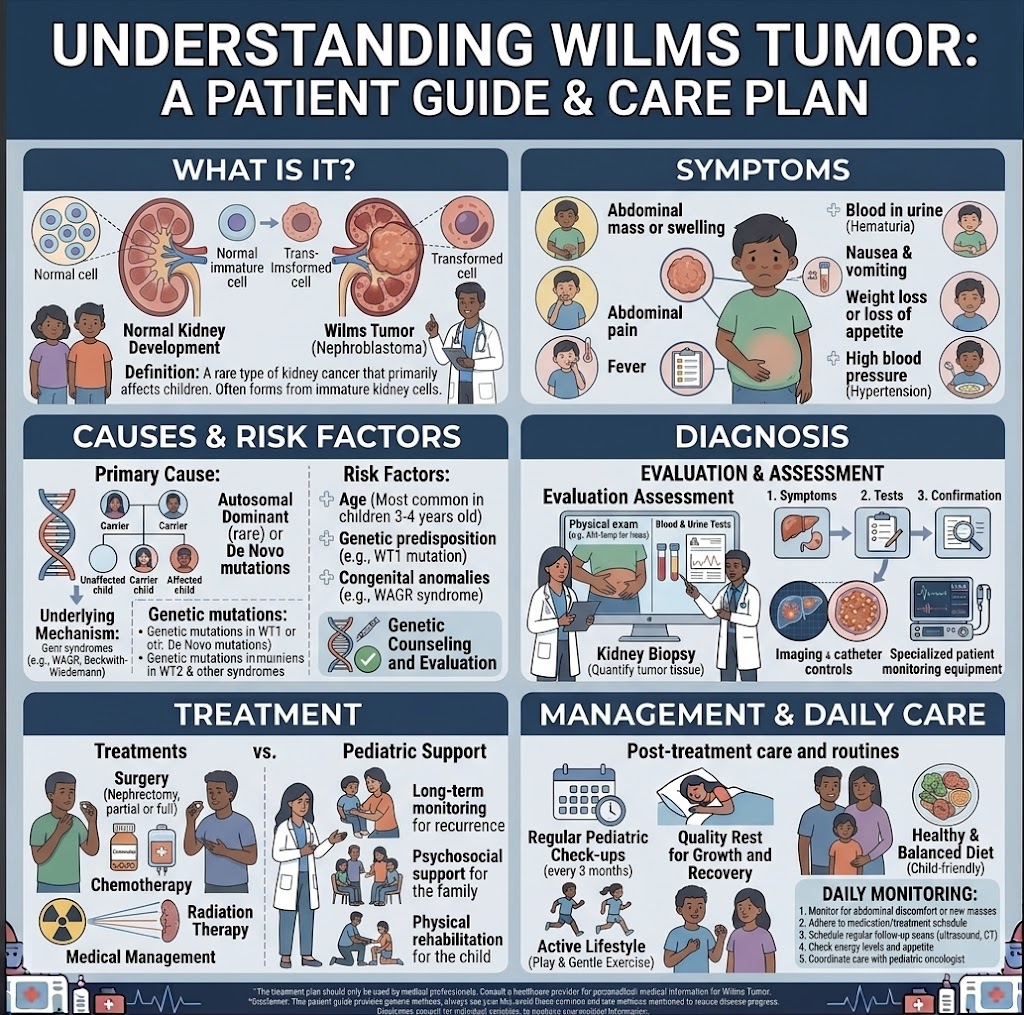
Wilms tumor, also known as nephroblastoma, is a rare kidney cancer that primarily affects children. It is the most common kidney cancer found in children, typically diagnosed between the ages of 3 and 4. While it usually develops in one kidney, it can occasionally affect both. Significant advancements in diagnosis and treatment over the years have greatly improved the outlook for most children with Wilms tumor, with a good prognosis with treatment.
Understanding the Condition
Wilms Tumor: Understanding a Childhood Kidney Cancer
Understanding the Condition
Common Symptoms
Abdominal Lump or Swelling: A noticeable mass or swelling in the belly area, which may or may not be painful when touched.
Abdominal Pain: Discomfort or pain in the stomach region.
Blood in Urine: Urine that appears pink, red, or tea-colored due to the presence of blood.
Tiredness and Paleness (Anemia): A low red blood cell count can lead to fatigue, weakness, and a pale appearance.
High Blood Pressure: Elevated blood pressure, which may be discovered during a routine check-up.
Consultation Guide
Which Specialist to Meet
If you notice any worrying symptoms, start by consulting your child's primary care doctor or pediatrician. They may then refer you to specialists such as a pediatric oncologist (a doctor specializing in childhood cancers), a pediatric urologist (a surgeon specializing in the urinary tract), or a nephrologist (a kidney specialist).
Preparations Before Your Visit
Before your appointment, make a note of all your child's symptoms, including when they started and how they've progressed. Be prepared to discuss your child's complete medical history and any relevant family medical history. List any questions or concerns you have so you don't forget them during the visit.
Book a doctor visit near me
A laboratory test that examines a sample of your child's urine. It can detect signs of infection, kidney disease, or other issues like blood in the urine, which is a common symptom of Wilms tumor.
Diagnostic Procedures
Wilms tumor, also known as nephroblastoma, is a rare kidney cancer that primarily affects children. It is the most common kidney cancer found in children, typically diagnosed between the ages of 3 and 4. While it usually develops in one kidney, it can occasionally affect both. Significant advancements in diagnosis and treatment over the years have greatly improved the outlook for most children with Wilms tumor, with a good prognosis with treatment.
An imaging test that uses high-frequency sound waves to create detailed pictures of organs inside the body, such as the kidneys. It's a non-invasive way to detect any growths or abnormalities.
What to Expect
Your child will lie comfortably on an examination table. A clear gel will be applied to the skin over their abdomen. A small handheld device, called a transducer, will be gently moved over the area. This procedure is painless and typically takes about 15 to 30 minutes to complete.
What to Expect
Your child will need to provide a urine sample. For older children, this is usually a 'clean catch' sample, where a mid-stream urine sample is collected after cleaning the genital area. For infants or very young children, a special collection bag may be used. The sample is then sent to a lab for analysis.
CT Scan (Computed Tomography)
An advanced imaging test that uses a series of X-rays taken from different angles to create detailed cross-sectional pictures of the kidneys and surrounding tissues. It provides more information than standard X-rays, helping doctors determine the tumor's exact size, location, and whether it has spread.
What to Expect
Your child will lie still on a table that slides into a large, donut-shaped machine. They may be given a special contrast dye, either by mouth or through an injection into a vein, to make certain body parts show up clearer on the images. The scan itself is painless, but the machine can be noisy. For very young children, sedation might be offered to help them remain still. The procedure typically lasts between 10 to 30 minutes.
A quick imaging test that uses a small amount of radiation to create pictures of the chest, including the lungs. It is often performed to check if the cancer has spread to the lungs, a common site for metastasis in Wilms tumor.
What to Expect
Your child will stand or sit in front of an X-ray plate, and a technician will help position them correctly. They will be asked to hold their breath briefly while the quick X-ray is taken. This is a fast and painless procedure, usually lasting only a few minutes.
Treatment Options
Surgical Procedures
Kidney Removal (Nephrectomy): This surgery involves removing all or part of the affected kidney. A 'radical nephrectomy' removes the entire kidney, while a 'partial nephrectomy' aims to remove only the tumor and a small amount of healthy tissue, preserving as much kidney function as possible. Surgery can be performed through a larger incision (open surgery) or through several small incisions (laparoscopic surgery, sometimes with robotic assistance). (Duration: The surgery itself takes several hours, followed by a hospital stay of several days for initial recovery. Full recovery can range from a few weeks to a few months.)
Medications and Therapies
Chemotherapy: Chemotherapy uses powerful anti-cancer medications, typically given intravenously (through a vein), to kill fast-growing cancer cells throughout the body. These drugs are designed to stop cancer cells from multiplying. (Duration: Chemotherapy is often given in cycles over several months, sometimes up to a year, depending on the tumor's stage and how well the child responds. Each cycle includes specific treatment days followed by rest periods.)
Radiation Therapy: Radiation therapy uses high-energy beams, such as X-rays or protons, precisely directed at the tumor area to destroy cancer cells and shrink tumors. It's frequently used after surgery or chemotherapy, particularly for larger tumors or when the cancer has spread. (Duration: Treatment is typically administered in short, daily sessions over several weeks. Each session for radiation delivery is usually brief, lasting only a few minutes.)
Scheduled Follow-Up Visits: After treatment, frequent and scheduled check-ups with the pediatric oncology team are crucial. These visits monitor for any recurrence of the tumor and help manage potential long-term side effects that may arise from the cancer therapies.
Prevention & Long-Term Wellbeing
Prevention/Early Detection
Genetic Counseling: If there is a family history of Wilms tumor or related genetic conditions, genetic counseling can help families understand their risks and options for future children.
Regular Screenings for At-Risk Children: For children born with certain specific conditions (e.g., partial or missing iris of the eye, or one side of the body being noticeably larger) or rare genetic syndromes, doctors may recommend regular kidney ultrasounds. These screenings help detect any tumor development at a very early stage.
Long-Term Monitoring and Support
Healthy Lifestyle: Encourage a balanced diet, regular physical activity, and adequate hydration. These practices are vital for supporting overall health and maintaining optimal function of the remaining kidney, especially if one kidney or part of a kidney has been removed.
Emotional Support: Provide ongoing emotional and psychological support for both the child and their family. This can include connecting with support groups, counseling services, or other resources to help cope with the experience of cancer and its aftermath.
Tags & Topics
Notice an error or need an update?
Help us keep medical information accurate. Report incorrect info or suggest an edit.


