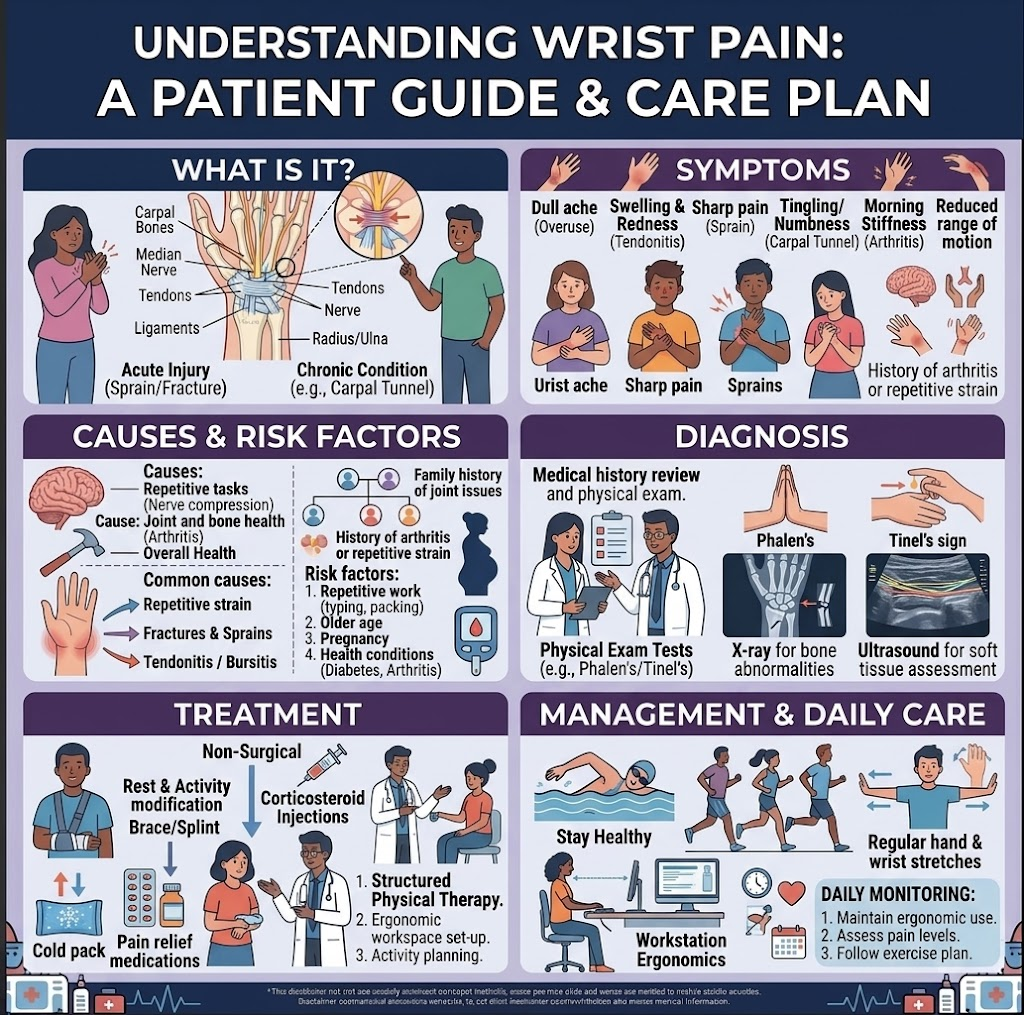
Wrist pain is a common issue that can significantly impact your ability to use your hand and wrist. It often arises from sudden events like sprains or fractures due to injuries, but it can also be a symptom of long-term problems such as repetitive strain, certain types of arthritis, or nerve compression like carpal tunnel syndrome. Because many factors can lead to wrist pain, accurately identifying the cause is crucial for effective treatment and proper healing.
Understanding the Condition
Understanding Wrist Pain
Understanding the Condition
Wrist pain is a common issue that can significantly impact your ability to use your hand and wrist. It often arises from sudden events like sprains or fractures due to injuries, but it can also be a symptom of long-term problems such as repetitive strain, certain types of arthritis, or nerve compression like carpal tunnel syndrome. Because many factors can lead to wrist pain, accurately identifying the cause is crucial for effective treatment and proper healing.
Common Symptoms
You should first consult your primary care doctor, who can assess your symptoms and may refer you to a specialist. Depending on the suspected cause of your wrist pain, you might be referred to an orthopedic surgeon (who specializes in bones, joints, and ligaments), a neurologist (for nerve-related issues like carpal tunnel syndrome), or a rheumatologist (for arthritis conditions).
Preparations Before Your Visit
Before your visit, make a list of your symptoms, including when they started, what makes them better or worse, their exact location, and how severe they are. Note any recent injuries, accidents, or repetitive activities that might have contributed to the pain. Also, be prepared to share your full medical history, including any other health conditions and all medications you are currently taking.
Book a doctor visit near me
Carpal Tunnel Release: A procedure to cut the ligament that is pressing on the median nerve in the wrist, relieving pressure and symptoms like tingling and numbness. (Duration: Recovery typically takes 2-4 weeks, with full strength returning over several months)
Adhere to Treatment Plans: For chronic conditions like arthritis or carpal tunnel syndrome, consistently follow all prescribed medical and therapeutic recommendations to manage symptoms and prevent potential worsening.
Maintain Healthy Weight: Managing a healthy body weight can reduce overall strain on your joints, which may benefit wrist health and potentially alleviate symptoms of certain conditions.
Regular Monitoring: Be attentive to any changes in your wrist pain or the appearance of new symptoms, and promptly report these to your doctor for timely assessment and intervention.
Consultation Guide
Varying Pain Sensation: The feeling of wrist pain can differ based on its origin. For instance, pain from a type of arthritis (osteoarthritis) might feel like a persistent, dull ache, similar to a toothache. On the other hand, carpal tunnel syndrome commonly causes a 'pins and needles' or tingling sensation, often affecting the thumb, index, and middle fingers, particularly at night. The precise location of your wrist pain also provides important clues to its underlying cause.
Prevent Falls: Wear stable footwear, clear tripping hazards in your home, ensure good lighting, and install grab bars in bathrooms and handrails on stairways, as falling onto an outstretched hand is a common cause of wrist injury.
Use Protective Gear: Wear wrist guards during high-risk sports and activities such as football, snowboarding, or inline skating to protect your wrists from impacts and injuries.
Practice Ergonomics: If your work or hobbies involve repetitive hand and wrist movements, take regular breaks. Maintain a neutral, relaxed wrist position when typing or performing tasks, and consider using ergonomic keyboards or wrist supports.
Diagnostic Procedures
When to Seek Medical Care: Minor wrist pain from sprains or strains may improve with simple home remedies like rest, ice, and over-the-counter pain relief. However, if your wrist pain and swelling persist for more than a few days, worsen over time, or significantly limit your ability to move your hand or wrist, it's important to see a healthcare professional. Delaying diagnosis and treatment can lead to poor healing, reduced movement, and potential long-term issues.
Consultation Guide
Which Specialist to Meet
An X-ray is a quick, painless imaging test that uses a small amount of radiation to create pictures of the structures inside your body, especially bones. It's highly effective for identifying bone fractures and dislocations.
What to Expect
You will be asked to position your wrist on an X-ray table. A technician will take images from different angles. You will need to hold still for a few seconds during each image capture. The procedure is non-invasive, painless, and typically takes only a few minutes.
CT Scan (Computed Tomography Scan)
A CT scan uses multiple X-ray images taken from various angles, which a computer then combines to create detailed cross-sectional pictures, or 'slices,' of your bones, blood vessels, and soft tissues. This provides much more detail than a standard X-ray, particularly for complex bone fractures or subtle changes in soft tissues.
What to Expect
You will lie on a motorized table that slides into a large, doughnut-shaped machine. You might hear some humming or clicking noises as the machine operates. It's important to stay very still during the scan, which can take 10-30 minutes. Sometimes, a special dye (contrast medium) may be given intravenously or orally to enhance the visibility of certain structures.
A bone scan is a nuclear imaging test used to diagnose and track various bone diseases. It involves injecting a small, safe amount of a radioactive tracer into your bloodstream. This tracer is absorbed more intensely in areas where bone cells are highly active, which can indicate issues like fractures, infections, or cancer spread that might not be visible on other imaging tests.
What to Expect
First, a small dose of the radioactive tracer will be injected into a vein, usually in your arm. You will then wait 2-4 hours for the tracer to circulate and be absorbed by your bones. After this waiting period, you will lie on a table while a special camera scans your body to detect the tracer's radiation. The scan itself is painless and typically takes 30-60 minutes.
Electromyography (EMG) and Nerve Conduction Study (NCS)
An EMG assesses the health of your muscles and the motor neurons (nerve cells) that control them. It typically includes two parts: a Nerve Conduction Study (NCS), which measures the speed and strength of electrical signals traveling through your nerves, and a needle EMG, which records the electrical activity within your muscles.
What to Expect
For the NCS, small electrode patches will be placed on your skin over specific nerves. Brief, mild electrical pulses will be sent through these electrodes, causing a quick, tingling or shock-like sensation, to measure how your nerves respond. For the needle EMG, a thin needle electrode will be inserted into various muscles in your wrist and arm. You might feel a brief pinch or discomfort. You’ll be asked to relax your muscles and then gently contract them so their electrical activity can be recorded. The entire procedure usually takes 30-60 minutes.
Arthroscopy is a minimally invasive surgical procedure used to diagnose and treat joint problems. A surgeon inserts a narrow tube with a tiny camera (arthroscope) through a small incision into your wrist joint. This allows them to view the inside of the joint on a video monitor without making a large open cut, enabling precise diagnosis and often immediate repair.
What to Expect
Treatment Options
Rest: Avoiding activities that aggravate the pain to allow the wrist to heal. (Duration: Days to weeks, as needed)
Ice Application: Applying ice packs to the affected area to reduce swelling and pain. (Duration: 15-20 minutes, several times a day for days)
Over-the-Counter Pain Relievers: Using non-prescription medicines to alleviate mild pain and reduce inflammation. (Duration: Short-term, as needed, typically for days)
Medications
Prescription Anti-inflammatory Medicines: Stronger prescription medications designed to reduce swelling and pain. (Duration: As prescribed by a doctor, from weeks to chronic management)
Oral Pain Relievers: Stronger pain medications prescribed by a doctor for more severe pain. (Duration: As prescribed, typically short-term)
Therapies
Physical or Occupational Therapy: Guided exercises and stretches to improve wrist strength, flexibility, and overall function, or learning modified ways to perform daily tasks to protect the wrist. (Duration: Several weeks to months, depending on progress)
Splinting or Bracing: Wearing a supportive device to immobilize or support the wrist, allowing it to rest and heal by preventing certain movements. (Duration: Weeks to months, often worn during specific activities or at night)
Corticosteroid Injections: Directly injecting powerful anti-inflammatory medication into the joint or around a nerve to quickly reduce swelling and pain. (Duration: Provides temporary relief, typically lasting weeks to months; not a permanent solution)
Surgical Procedures
Arthroscopy: A minimally invasive surgery to repair damaged cartilage, ligaments, or remove loose bone fragments inside the wrist joint, guided by a small camera. (Duration: Recovery typically takes 4-8 weeks, with full recovery potentially longer)
Surgery for Kienbock Disease: Various procedures aimed at restoring blood supply to the affected bone, removing pressure, or stabilizing the wrist to prevent further bone collapse. (Duration: Recovery can be several months due to bone healing)
Prevention & Long-Term Wellbeing
This procedure is performed in a hospital or surgical center, typically under general or regional anesthesia. One or more small incisions (often referred to as 'buttonholes') are made around the wrist. The arthroscope is inserted, and sterile fluid is often pumped into the joint to improve visibility. Small surgical instruments can also be inserted through other tiny incisions to repair damaged cartilage, ligaments, or remove loose fragments. Afterward, the incisions are closed with stitches. You will receive detailed instructions for wound care, pain management, and activity restrictions during your recovery, which can take several weeks.
Ganglion Cyst Removal: Surgical removal of a fluid-filled sac that forms near a joint or tendon, which may be causing pain or discomfort. (Duration: Recovery typically takes 2-4 weeks)
Prevention
Build Bone Strength: Ensure your diet includes adequate amounts of calcium and vitamin D, or consider supplements, to help maintain strong bones and prevent fractures.
Tags & Topics
Notice an error or need an update?
Help us keep medical information accurate. Report incorrect info or suggest an edit.


