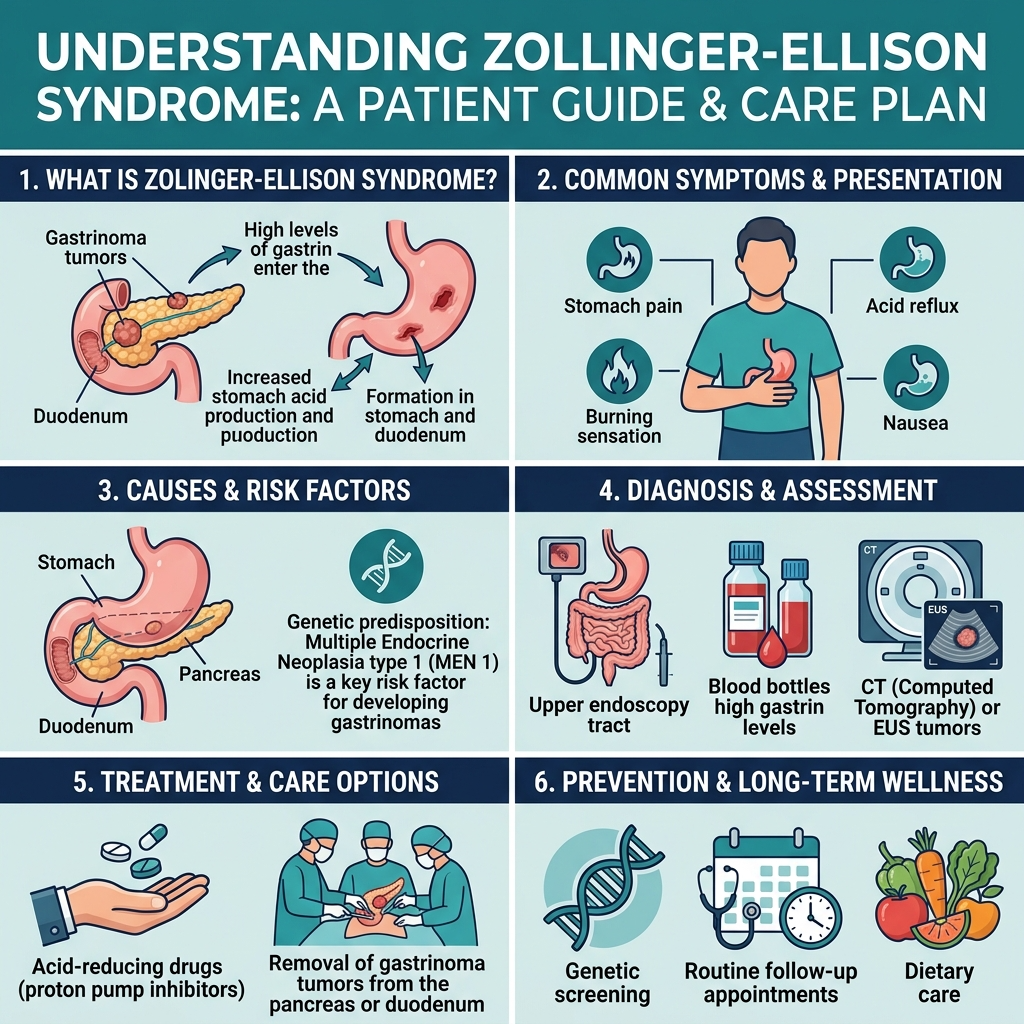
Zollinger-Ellison syndrome (ZES) is a rare condition marked by tumors, called gastrinomas, typically in the pancreas or small intestine. These tumors release excessive gastrin, causing the stomach to produce too much acid. This leads to severe stomach ulcers and symptoms like diarrhea and belly pain. ZES is most often found in people aged 20-50. Treatment usually involves acid-reducing medications and sometimes surgery to remove tumors.
Understanding the Condition
Zollinger-Ellison Syndrome: A Comprehensive Guide
Understanding the Condition
Zollinger-Ellison syndrome (ZES) is a rare condition marked by tumors, called gastrinomas, typically in the pancreas or small intestine. These tumors release excessive gastrin, causing the stomach to produce too much acid. This leads to severe stomach ulcers and symptoms like diarrhea and belly pain. ZES is most often found in people aged 20-50. Treatment usually involves acid-reducing medications and sometimes surgery to remove tumors.
Common Symptoms
Stomach pain: Discomfort or aches in the abdominal area.
Burning, aching or discomfort in your upper belly: A persistent, uncomfortable sensation.
Acid reflux and heartburn: A burning sensation in the chest and throat from stomach acid flowing back up.
Nausea and vomiting: Feeling sick to your stomach and throwing up.
Bleeding in your digestive tract: Can manifest as dark stools or vomiting blood, indicating serious irritation or ulcers.
Losing weight without trying: Unintentional decrease in body weight.
Loss of appetite: A reduced desire to eat.
Consultation Guide
Which Specialist to Meet
You should consult a gastroenterologist (a doctor specializing in digestive system disorders) or an endocrinologist (a doctor specializing in hormone-related conditions, especially if your syndrome is linked to an inherited condition like Multiple Endocrine Neoplasia type 1). A surgical oncologist may also be involved if tumor removal is considered.
Preparations Before Your Visit
Before your visit, make a list of all your symptoms, including when they started and how often they occur. Be sure to mention any over-the-counter medicines you're taking to reduce stomach acid, as these can mask symptoms and delay diagnosis. Gather your medical history and any known family history of inherited conditions, particularly Multiple Endocrine Neoplasia type 1. You may be asked to fast before certain diagnostic tests.
Book a doctor visit near me
Acid-Reducing Medicines: These medications significantly reduce the amount of acid produced by the stomach, helping to heal ulcers and relieve symptoms like pain, heartburn, and reflux. They work by blocking the cells that produce acid. (Duration: Often required long-term, potentially for life, to manage acid production and prevent recurrence of ulcers.)
Early Detection and Monitoring: For individuals at risk due to family history, regular screenings and monitoring can help detect tumors early, potentially before they cause significant symptoms or spread.
Adherence to Medication Regimen: Consistently taking prescribed acid-reducing medications as directed is essential to control stomach acid, prevent ulcers, and manage symptoms.
Consultation Guide
Liver Transplant: In very rare cases, if the cancer has spread extensively to the liver and caused severe damage, or if the primary tumor is liver cancer, a liver transplant may be considered to replace the diseased liver with a healthy one. This is a complex procedure. (Duration: A one-time major surgery. Requires lifelong medication to prevent organ rejection.)
Genetic Counseling for MEN 1: If there's a family history of Multiple Endocrine Neoplasia type 1 (MEN 1), which is a common cause of ZES, genetic counseling can help assess risk and guide early screening for family members.
Diagnostic Procedures
Computed Tomography (CT) Scan
Uses X-rays and computer processing to create detailed cross-sectional images of bones, blood vessels, and soft tissues. This helps locate tumors and assess their spread within the body.
What to Expect
You will lie on a motorized table that slides into a large, donut-shaped scanner. You must lie still, and you might be asked to hold your breath briefly. Sometimes, a special dye (contrast material) might be given intravenously or swallowed to make certain areas show up more clearly. The entire procedure usually takes 15 to 30 minutes.
Endoscopic Ultrasound (EUS)
EUS combines endoscopy and ultrasound. A thin, flexible tube (endoscope) with a tiny ultrasound device at its tip is guided down your throat. This device emits sound waves to create detailed images of your digestive tract lining and nearby organs like the pancreas and lymph nodes. It can also be used to collect tissue samples (biopsy) using a fine needle.
What to Expect
You will receive a sedative to help you relax or sleep during the procedure. The endoscope will be gently inserted down your throat. You may feel some pressure as the scope moves. The ultrasound will generate images, and if a biopsy is needed, a small needle will be passed through the scope to collect a sample. The procedure typically lasts 30 to 90 minutes, and you'll need someone to drive you home afterward.
This diagnostic imaging technique uses high-frequency sound waves to create real-time pictures of structures inside your body. It's often used to view organs and soft tissues. Most ultrasounds are performed externally, using a device on the skin.
What to Expect
For an external ultrasound, a clear gel is applied to your skin over the area to be examined. A small handheld device called a transducer is then pressed against your skin and moved around. The sound waves bounce off internal organs and are converted into images on a screen. You might feel slight pressure from the transducer. Depending on the area being scanned, you might need to fast or have a full bladder before the test. The procedure is generally quick, lasting 15 to 45 minutes.
Upper Endoscopy (Esophagogastroduodenoscopy or EGD)
An upper endoscopy involves a doctor inserting a long, flexible tube with a camera (endoscope) down your throat to visually inspect the lining of your esophagus, stomach, and the first part of your small intestine (duodenum). This allows direct visualization of ulcers or other abnormalities.
What to Expect
You will be given a sedative and possibly a local anesthetic to numb your throat. You will lie on your side, and the endoscope will be carefully guided through your mouth into your digestive tract. Air may be gently inflated to improve the view. You may feel some pressure or fullness, but you should not feel pain. The doctor can take tissue samples (biopsies) if needed. The procedure usually takes 15 to 30 minutes, and you will need someone to drive you home.
Monitoring for Tumor Recurrence/Spread: Regular imaging tests (like CT scans or EUS) will be performed to check for any regrowth of tumors or if they have spread to other parts of the body, especially the liver or lymph nodes.
Management of MEN 1 (if applicable): If ZES is part of MEN 1, you will also need ongoing monitoring and management for other potential tumors or hormone imbalances associated with this syndrome (e.g., in parathyroid or pituitary glands).
Treatment Options
Medications
Chemotherapy: A drug treatment that uses powerful chemicals to kill fast-growing cancer cells throughout the body. It may be used if the tumors are cancerous and have spread, or cannot be fully removed by surgery. (Duration: Administered in cycles over several months or longer, depending on the type and stage of cancer, and the patient's response.)
Radiofrequency Ablation (RFA) for Tumors: A minimally invasive procedure that uses electrical energy and heat to destroy cancer cells. A needle is guided to the tumor, and heat is applied to kill the cells. It's often used for smaller tumors or to manage pain when surgery is not an option. (Duration: Usually a single session or a few sessions, depending on the number and size of tumors. Recovery is generally quicker than open surgery.)
Regular Medical Follow-ups: Consistent appointments with your specialist are crucial for monitoring your condition, adjusting medication, and screening for tumor recurrence or spread.
Prevention & Long-Term Wellbeing
Tumor Removal (Surgical Resection): This involves surgically locating and removing the gastrinoma tumors. The goal is to remove as many tumors as possible, especially if they are localized and haven't spread. (Duration: A one-time surgical procedure. Recovery time varies but typically involves several weeks.)
Prevention
Healthy Lifestyle Choices: Maintaining a balanced diet, staying hydrated, engaging in regular physical activity, and avoiding smoking and excessive alcohol can support overall health and potentially alleviate some digestive discomfort, though they do not directly treat the syndrome.
Tags & Topics
Notice an error or need an update?
Help us keep medical information accurate. Report incorrect info or suggest an edit.


